Sclareol
Labd-14-ene-8,13-diol
13-epi-Sclareol
化学組成 · Constituent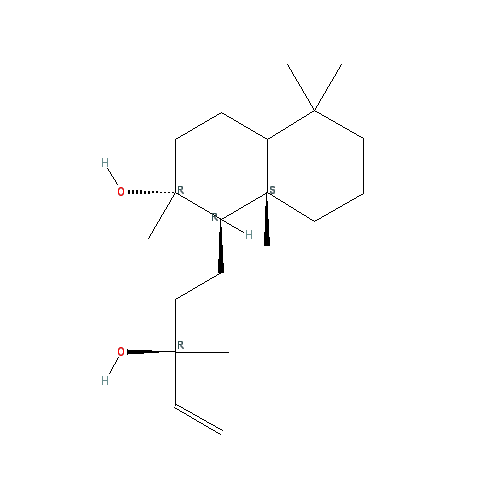
Labd-14-ene-8,13-diol
13-epi-Sclareol
化学組成 · Constituent
Sclareol has extremely low volatility, so it appears only as a small percentage when analyzed by GC. HPLC analysis shows that clary sage absolute typically contains 70 to 75 percent sclareol and 13-epi-sclareol. The natural compound is safe at standard concentrations.
Skin. Undiluted material was irritating to rabbit skin, while 3 percent was not. At 10 percent on 25 volunteers it was not irritating. Three 10 percent samples tested on 106 individuals showed no irritation. One sample produced 1 of 29 and 3 of 26 sensitization reactions, while the other two samples produced none. In human repeat insult patch tests at 3 percent on 35 and 39 volunteers it was not sensitizing.
Oral. Acute oral LD50 in rats exceeded 5 g/kg. Acute dermal LD50 in rabbits exceeded 5 g/kg.
Subchronic. Rats given 8.8 mg/kg/day sclareol by gavage for 30 days showed only marginal toxicity. The rat NOAEL is 8.8 mg/kg/day.
Cancer. Sclareol shows strong cytotoxicity against many human and animal cancer cell lines, inducing apoptosis. 13-epi-Sclareol inhibits breast and uterine cancer cells more potently than Tamoxifen while sparing normal cells.
| Clary sage | 2.4 % (GC) · 70 – 75 % (HPLC) |
Sclareol is a key constituent of clary sage absolute and the industrial starting material for the synthesis of ambroxide, the synthetic ambergris note used widely in perfumery.