Thymol
2-Isopropyl-5-methylphenol
2-(1-Methylethyl)-5-methylphenol · p-Cymen-3-ol · Thyme camphor
化学組成 · Constituent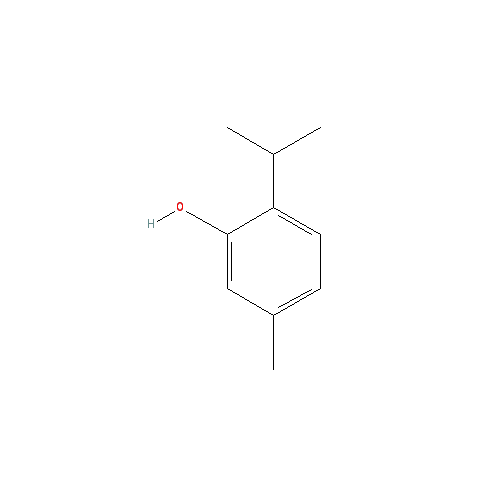
2-Isopropyl-5-methylphenol
2-(1-Methylethyl)-5-methylphenol · p-Cymen-3-ol · Thyme camphor
化学組成 · Constituent
Thymol là phenol thế nên có tính axit yếu và có thể ăn mòn mô. Được dùng truyền thống trong nước súc miệng sát khuẩn và hỗn hợp xông hơi. Đồng phân với carvacrol.
Trên da. Patch test bịt kín 48 giờ trên 50 tình nguyện cho nồng độ tối đa không phản ứng là 5 phần trăm. Ở 1 phần trăm không phản ứng trên 290 bệnh nhân eczema và 1.200 bệnh nhân viêm da. Ở 70 bệnh nhân viêm da tiếp xúc không phản ứng. Có hai trường hợp viêm da tiếp xúc dị ứng được ghi nhận. Phân loại Category C, không gây dị ứng đáng kể.
Niêm mạc. Thymol kích ứng niêm mạc dạ dày, chất béo và cồn tăng hấp thu và làm nặng triệu chứng. Tuy nhiên một số tinh dầu Lippia sidoides chứa 67 phần trăm thymol khi uống 1, 5 và 10 mg/kg ức chế tổn thương dạ dày do cồn, hiệu ứng đảo ngược khi tăng liều.
Đường uống. LD50 cấp tính 1.800 mg/kg trên chuột nhắt, 980 mg/kg trên chuột và 880 mg/kg trên chuột lang. Liều tử vong tiêm tĩnh mạch trên chó 150 mg/kg.
Bán mãn tính. Cho chuột ăn 1.000 hoặc 10.000 ppm thymol trong 19 tuần không có tác dụng phụ.
Tim mạch. Thymol ức chế kết tập tiểu cầu do axit arachidonic, mạnh hơn aspirin trên 30 lần.
Gan. Có giả thuyết liên hệ thymol làm chất chống oxi hoá trong halothane với tổn thương gan hiếm gặp. Trên tế bào gan chuột cô lập, thymol 0.2 đến 4 mM tăng rò GOT theo liều. Tuy nhiên thymol cũng bảo vệ gan chuột khỏi tổn thương do carbon tetrachloride qua hoạt tính bắt gốc tự do.
Đột biến gen. Kết quả phụ thuộc liều và mô hình. Ở liều thấp, thymol không gây độc gen và bảo vệ tế bào lympho khỏi tổn thương DNA. Ở liều cao gây độc gen. Khả năng gây độc gen tổng thể được coi là rất yếu.
Thymol is a substituted phenol with weak acid activity and tissue corrosive potential. It is traditionally used in antiseptic mouthwashes and inhalation mixtures. Isomeric with carvacrol.
Skin. A 48-hour occlusive patch test on 50 volunteers gave a no-reaction maximum of 5 percent. At 1 percent there were no reactions in 290 eczema patients or 1,200 dermatitis patients. In 70 contact dermatitis patients no reactions occurred. Two cases of allergic contact dermatitis to thymol have been reported. Classified as Category C, not significantly allergenic.
Mucous. Thymol irritates the gastric mucosa, with fats and alcohol increasing absorption and aggravating symptoms. However, oral Lippia sidoides oil with 67 percent thymol at 1, 5 and 10 mg/kg inhibited alcohol-induced gastric lesions, with the effect reversing at higher doses.
Oral. Acute oral LD50 was 1,800 mg/kg in mice, 980 mg/kg in rats and 880 mg/kg in guinea pigs. Dog intravenous lethal dose was 150 mg/kg.
Subchronic. Rats fed 1,000 or 10,000 ppm thymol for 19 weeks showed no adverse effects.
Cardiovascular. Thymol inhibits arachidonic acid-induced platelet aggregation, over 30 times more potently than aspirin.
Liver. A hypothesis links thymol as an antioxidant in halothane to a rare form of severe liver damage. In isolated rat hepatocytes, thymol at 0.2 to 4 mM dose-dependently increased GOT leakage. However, thymol also protected rat liver from carbon tetrachloride-induced damage through free radical scavenging.
Mutagenicity. Results depend on dose and assay. At low concentrations thymol was not genotoxic and protected lymphocytes from DNA damage. At higher concentrations it was genotoxic. Overall genotoxic potential is considered very weak.
| Cỏ xạ hương · Thyme (thymol CT, carvacrol CT, thymol/carvacrol CT) | 30.9 – 74.0 % |
| Kinh giới Mexico · Oregano (Mexican) | 0.2 – 60.6 % |
| Ajowan | 36.9 – 53.8 % |
| Cỏ xạ hương · Thyme (limonene CT) | 27.6 % |
| Cỏ xạ hương · Thyme (borneol CT) | 10.0 % |
| Savory · Savory (summer + winter) | 1.0 – 8.0 % |
| Kinh giới · Oregano | 0.3 – 4.4 % |
| Cỏ xạ hương · Thyme (linalool CT) | 1.0 – 3.8 % |
| Linh sam Canada (kim) · Fir needle (Canadian) | 0 – 2.9 % |
| Damiana | 2.3 % |
| Ngải Tansy xanh · Tansy (blue) | 0.8 – 1.8 % |
| Hạt giun · Wormseed | 1.0 % |
Thymol được thải chủ yếu dưới dạng glucuronide và sulfate qua nước tiểu ở thỏ, chó và người. Một lượng nhỏ chuyển thành thymoquinol. Sau khi uống 0.6 g thymol, người thải thymol glucuronide, thymol sulfate, một ít thymoquinol sulfate và thymol không chuyển hoá qua nước tiểu.
Sau khi uống 1.08 mg thymol, nồng độ huyết tương đỉnh đạt 93.1 ng/mL sau 2 giờ. Bán thải cuối khoảng 10.2 giờ. Thymol sulfate phát hiện được tới 41 giờ sau khi uống. Tổng thymol sulfate và glucuronide thải trong 24 giờ là 16.2 phần trăm liều.
Thymol is primarily excreted as glucuronide and sulfate conjugates in rabbits, dogs and humans. A small amount is oxidized to thymoquinol. After ingestion of 0.6 g of thymol, humans excrete thymol glucuronide, thymol sulfate, small amounts of thymoquinol sulfate and unchanged thymol in urine.
After ingestion of 1.08 mg of thymol, peak plasma concentration reached 93.1 ng/mL at 2 hours. The terminal elimination half-life was about 10.2 hours. Thymol sulfate was detectable up to 41 hours after administration. Total urinary excretion of thymol sulfate and glucuronide over 24 hours was 16.2 percent of the dose.
Thymol và carvacrol cùng là các phenol monoterpene chính trong thyme và oregano, có hoạt tính kháng khuẩn và kháng nấm mạnh, được nghiên cứu cho ứng dụng trong sản phẩm chăm sóc răng miệng và bảo quản tự nhiên.
Cấu trúc thymol gần với carvacrol nhưng vị trí nhóm methyl và isopropyl đảo ngược. Cả hai có hoạt tính sinh học tương tự.
Thymol and carvacrol are the principal monoterpene phenols in thyme and oregano. They show strong antibacterial and antifungal activity and are studied for oral care products and natural preservation.
Thymol's structure is close to carvacrol, with the methyl and isopropyl groups in reversed positions. Both compounds share similar biological activity.