Psoralen
7H-Furo[3,2-g][1]benzopyran-7-one
Ficusin · Furo[3,2-g]coumarin
化学組成 · Constituent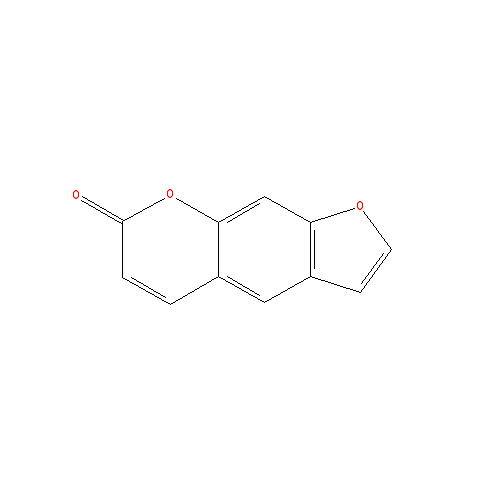
7H-Furo[3,2-g][1]benzopyran-7-one
Ficusin · Furo[3,2-g]coumarin
化学組成 · Constituent
Psoralen is one of a group of furanocoumarins causing significant photosensitization and phototoxicity in animals and humans. The European Union and SCCP impose strict limits in cosmetics.
Phototoxicity. In combination with UVA, psoralen causes DNA damage and persistent skin darkening. It is the constituent that makes rue, bitter orange and non-FCF bergamot oils highly phototoxic.
Mutagenicity. Psoralen was positive in the SOS chromotest and genotoxic in human lymphocytes and HepG2 hepatoma cells. It was mutagenic in HPRT assay and photogenotoxic in a micronucleus assay above 5 µg/mL.
CYP interaction. Psoralen is a potent inhibitor of microsomal CYP3A with an IC50 of 5.1 µM. It inhibits CYP3A4 more weakly with IC50 of 116 to 257 µM in human liver.
| Rue | 0.015 % |
| Angelica root | 0.0112 % |
| Taget | 0.011 % |
| Orange (bitter) | 0.007 % |
| Bergamot | 0 – 0.0026 % |
Psoralen is used medically alongside UVA in PUVA therapy for psoriasis and vitiligo under strict supervision. In cosmetics and fragrance, psoralen and related furanocoumarins are limited to 1 ppm.