Octyl acetate
Octyl ethanoate
n-Octyl acetate · n-Octanyl acetate · Acetic acid octyl ester
化学組成 · Constituent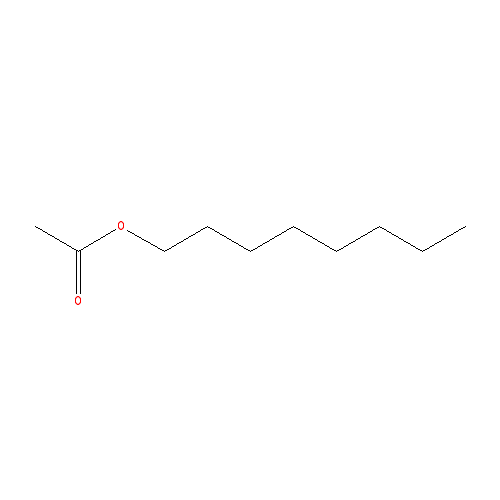
Octyl ethanoate
n-Octyl acetate · n-Octanyl acetate · Acetic acid octyl ester
化学組成 · Constituent
Octyl acetate is an aliphatic ester present at high levels in one frankincense species (Boswellia papyrifera).
Skin. Undiluted octyl acetate was slightly irritating to rabbit skin under 24-hour occlusion. Tested at 8 percent on 24 volunteers, the material caused no irritation and no sensitization.
Acute toxicity. Acute oral LD50 in rats 3 g/kg. Acute dermal LD50 in rabbits exceeded 5 g/kg.
Subchronic toxicity. In a gavage study, rats received 100, 500 or 1,000 mg/kg/day for 13 weeks. At the high dose, slight reductions in body weight and food consumption, increased liver and kidney weights, and hydrocarbon nephropathy in high-dose males were observed. Increased mid-dose liver weight was considered a compensatory response to metabolic load, not true hepatotoxicity.
Reproductive. Pregnant Sprague-Dawley rats received 100, 500, 1,000 mg/kg via oral gavage on gestational days 6 to 15. Mid- and high-dose levels caused maternal toxicity through reductions in body weight gain and food consumption. There were no statistically significant effects on embryo-fetal lethality or fetal growth. Malformed fetus rates increased significantly only in the high-dose group. NOAEL 100 mg/kg/day.
| Frankincense | 0 – 60.0 % (Boswellia papyrifera) |
Octyl acetate is the dominant ester in Boswellia papyrifera oil, a Sudanese-Eritrean frankincense species. In other frankincense species such as Boswellia sacra and Boswellia frereana, octyl acetate is present only at low levels (up to 1.5 percent).