Isobornyl acetate
exo-1,7,7-Trimethylbicyclo[2.2.1]heptan-2-yl ethanoate
exo-Bornanyl acetate · exo-2-Camphanyl acetate · Acetic acid isobornyl ester
化学組成 · Constituent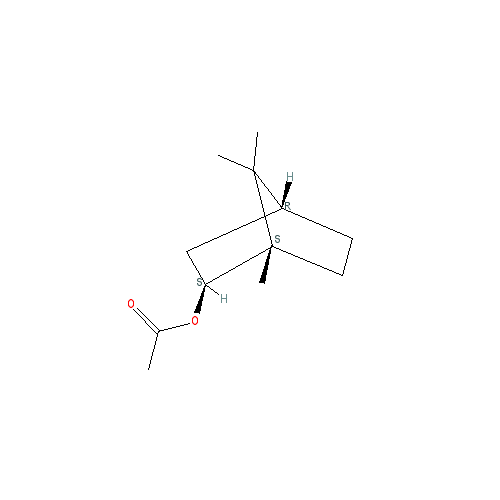
exo-1,7,7-Trimethylbicyclo[2.2.1]heptan-2-yl ethanoate
exo-Bornanyl acetate · exo-2-Camphanyl acetate · Acetic acid isobornyl ester
化学組成 · Constituent
Isobornyl acetate is the dominant constituent in hemlock spruce oil. Isomeric with bornyl acetate.
Skin. Applied undiluted to rabbit skin, it was mildly irritating. A 10 percent patch test on 25 volunteers produced no sensitization. At 5 percent on 100 consecutive dermatitis patients, no irritation or allergic reactions occurred.
Oral and dermal. Acute oral LD50 in rats exceeds 10 g/kg. Acute dermal LD50 in rabbits exceeds 20 g/kg, a very high level.
Subchronic. A 90-day rat gavage study at 15, 90 or 270 mg/kg showed signs of nephrotoxicity at the two higher doses. The NOAEL was 15 mg/kg/day.
| Spruce (hemlock) | 34.7 % |
Isobornyl acetate contributes a pine-forest note to hemlock spruce and other spruce oils. It is widely used in men's fragrance and household products.