Fenchone
1,3,3-Trimethylbicyclo[2.2.1]heptan-2-one
1,3,3-Trimethyl-2-norbornanone · 1,3,3-Trimethyl-2-norcamphanone
化学組成 · Constituent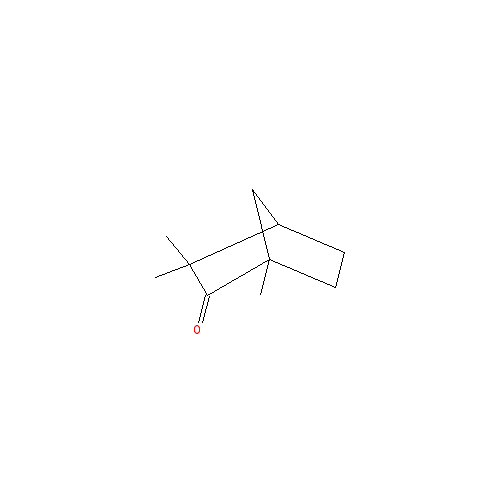
1,3,3-Trimethylbicyclo[2.2.1]heptan-2-one
1,3,3-Trimethyl-2-norbornanone · 1,3,3-Trimethyl-2-norcamphanone
化学組成 · Constituent
Fenchone là một monoterpenoid ketone xuất hiện đáng kể trong tinh dầu lavender Tây Ban Nha, thì là đắng và thuja. Hồ sơ an toàn cho thấy hợp chất tương đối lành tính ở liều thông thường.
Trên da. Patch test ở 4 phần trăm trên người không gây kích ứng cũng không gây mẫn cảm.
Đường uống và da. LD50 cấp tính qua đường uống trên chuột 6.16 g/kg. LD50 trên thỏ qua da vượt 5 g/kg.
Thần kinh. Tiêm dưới da 1.133 mg/kg trên chuột nhắt gây co giật, không co giật ở 500 mg/kg. Trên chó uống 16 ngày, gây co giật chí tử ở 1.400 mg/kg/ngày, run thoáng qua ở 750 mg/kg/ngày, không tác động ở 210 – 420 mg/kg/ngày. Liều rất cao không đại diện cho liều điều trị.
Đột biến gen. Không gây đột biến trong các chủng Salmonella TA97, TA98, TA100 hoặc TA1535. Không gây độc gen trong micronucleus test trên tuỷ xương chuột.
Fenchone is a monoterpenoid ketone occurring substantially in Spanish lavender, bitter fennel and thuja oils. Its safety profile shows the compound is relatively benign at standard use levels.
Skin. A 4 percent patch test on human subjects produced neither irritation nor sensitization.
Oral and dermal. Acute oral LD50 in rats is 6.16 g/kg. Acute dermal LD50 in rabbits exceeds 5 g/kg.
Neurology. Subcutaneous injection at 1,133 mg/kg in mice produced convulsions, but not at 500 mg/kg. In a 16-day oral study in dogs, it was convulsant and lethal at 1,400 mg/kg/day, produced transient tremors at 750 mg/kg/day, and had no apparent effects at 210 to 420 mg/kg/day. The very high doses are not representative of therapeutic use.
Mutagenicity. Not mutagenic in Salmonella strains TA97, TA98, TA100 or TA1535. Not genotoxic in rat bone marrow micronucleus tests.
| Oải hương Tây Ban Nha · Lavender (Spanish) | 14.9 – 49.1 % |
| Thì là đắng · Fennel (bitter) | 4.0 – 24.0 % |
| Trắc bá · Thuja | 12.2 – 12.8 % |
| Thì là ngọt · Fennel (sweet) | 0.2 – 8.0 % |
| Tuyết tùng Port Orford · Cedarwood (Port Orford) | 4.7 % |
| Labdanum | 1.4 – 2.3 % |
| Thông Scotland · Pine (Scots) | 0 – 2.1 % |
| Xô thơm hoang Phi · Sage (African wild) | 1.4 % |
| Cistus | 0 – 1.1 % |
Trên cả chó và thỏ, fenchone được chuyển hoá qua hydroxyl hoá. 4-Hydroxyfenchone và 5-hydroxyfenchone xuất hiện trong nước tiểu chó, trong khi 8-, 9- và 10-hydroxyfenchone xuất hiện trong nước tiểu thỏ.
In both dogs and rabbits, fenchone is metabolized by hydroxylation. 4-Hydroxyfenchone and 5-hydroxyfenchone appear in dog urine, while 8-, 9- and 10-hydroxyfenchone appear in rabbit urine.
Quy định Pháp về fenchone trong absinthe có từ năm 1915, là phản ứng pháp lý với điều được cho là độc tính absinthe lúc đó, không dựa trên dữ liệu độc lý hiện đại.
The French regulation on fenchone in absinthe dates from 1915, a legislative response to what was perceived as absinthe toxicity at the time. It is not based on modern toxicological data.