Methyl isoeugenol
3,4-Dimethoxy-(1-propenyl)benzene
O-Methyl isoeugenol · Isoeugenol methyl ether · 4-Propenylveratrole
化学組成 · Constituent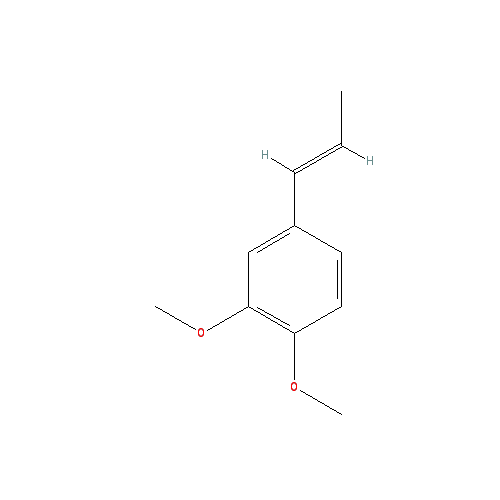
3,4-Dimethoxy-(1-propenyl)benzene
O-Methyl isoeugenol · Isoeugenol methyl ether · 4-Propenylveratrole
化学組成 · Constituent
Methyl isoeugenol is an isomer of methyleugenol with higher skin sensitization activity than methyleugenol.
Skin. In a worldwide multicenter study on 218 dermatitis patients with proven fragrance sensitization, 16 (7.3 percent) reacted positively to 5 percent methyl isoeugenol.
Subchronic toxicity. Rats fed 30, 100, 300 mg/kg/day for 28 days showed only minor high-dose changes such as serum chemistry alterations, increased liver weight and white blood cell counts, with no toxicological significance.
| Citronella | 0 – 10.7 % |
| Tuberose | 32.5 % |
| Calamus (tetraploid form) | tr – 2.8 % |
| Narcissus | 0 – 1.6 % |
Metabolism is similar to methyleugenol but 4-O-demethylation is more important. Principal metabolites are 3,4-dimethoxycinnamic acid and 3,4-dimethoxybenzoic acid as glycine conjugates, and 3-methoxy-4-hydroxycinnamic acid.
Methyl isoeugenol exists in two geometric isomers, (E)- and (Z)-, both occurring in Sri Lankan citronella oil. Although structurally close to methyleugenol, this compound does not have an IFRA limit for cancer risk.