Isopinocamphone
2,6,6-Trimethylbicyclo[3.1.1]heptan-3-one
3-Pinanone · (Z)-Pinocamphone · cis-Pinocamphone
化学組成 · Constituent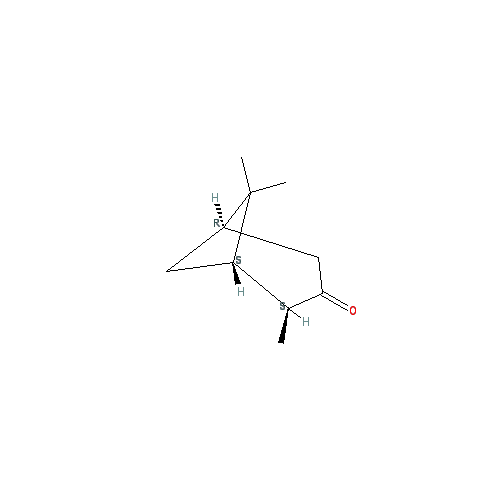
2,6,6-Trimethylbicyclo[3.1.1]heptan-3-one
3-Pinanone · (Z)-Pinocamphone · cis-Pinocamphone
化学組成 · Constituent
Isopinocamphone is a convulsant monoterpenoid ketone isomeric with pinocamphone. It is the main constituent in pinocamphone-CT hyssop oil.
Neurology. The compound is partly responsible for the neurotoxicity of hyssop oil. In ip LD50 testing, mice exhibited neurological signs 1 to 2 minutes after injection, progressing to generalized unremitting convulsions followed by either death or recovery. Isopinocamphone acts as a GABA-gated chloride channel blocker, and its convulsant activity can be reversed by diazepam.
The lowest known convulsant dose of pinocamphone isomers in humans is around 210 mg (10 drops of hyssop oil containing 70 percent pinocamphone and isopinocamphone), equivalent to 3 mg/kg.
Oral. Acute ip LD50 in mice is 175 mg/kg. Isopinocamphone is 1.4 times more toxic than pinocamphone.
| Hyssop (pinocamphone CT) | 30.9 – 39.2 % |
| Rosemary | 1.2 – 2.9 % |
| Cistus | 0 – 2.5 % |
| Hyssop (linalool CT) | 1.0 – 1.5 % |
Isopinocamphone is metabolized in vitro and in vivo primarily by CYP enzymes to hydroxylated derivatives. This has been proposed as a detoxification pathway.
Isopinocamphone is structurally and toxicologically similar to thujone. Both are convulsant, both noncompetitively inhibit GABA-A receptors, and both are metabolized by CYP to less toxic derivatives. Human convulsant doses of the two are also comparable.