Menthofuran
3,6-Dimethyl-4,5,6,7-tetrahydrobenzo[b]furan
3,9-Epoxy-p-mentha-3,8-diene
化学組成 · Constituent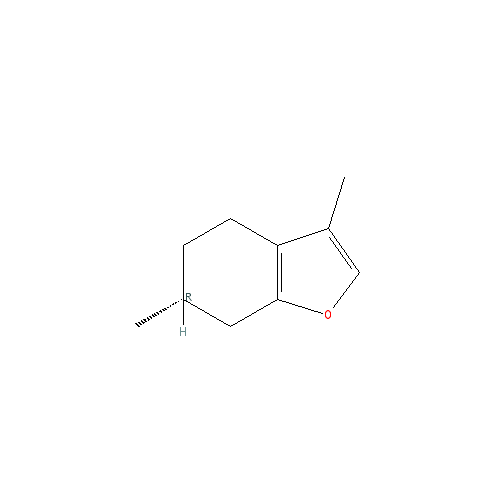
3,6-Dimethyl-4,5,6,7-tetrahydrobenzo[b]furan
3,9-Epoxy-p-mentha-3,8-diene
化学組成 · Constituent
Menthofuran là furanoid monoterpenoid xuất hiện ở mức nhỏ trong tinh dầu bạc hà và palo santo. Hợp chất độc gan đáng kể, khoảng gấp đôi pulegone.
Độc tính gan. Liều uống 250 mg/kg/ngày trong 3 ngày trên chuột gây tổn thương gan, thể hiện qua thay đổi các marker enzyme gan. Menthofuran phá huỷ CYP gan và liên kết mạnh với protein gan chuột, gấp ba lần so với phổi và thận.
Chuyển hoá sinh độc. Menthofuran được kích hoạt qua một epoxide thành 8-pulegone aldehyde, một chất chuyển hoá phản ứng mạnh, có thể là chất độc cuối cùng. Liều thấp được bảo vệ bởi glutathione gan.
Độc tính cấp. Không có giá trị LD50 được công bố. Tiêm phúc mạc 200 mg/kg gây chết 5 trên 15 chuột nhắt trong 24 giờ. LD50 phúc mạc trên chuột nhắt ước tính khoảng 250 mg/kg.
Khuyến nghị an toàn. Liều an toàn đề xuất là một nửa pulegone, tương đương 0.2 mg/kg/ngày, hoặc 14 mg cho người lớn đường uống, hoặc 0.5 phần trăm qua da.
Menthofuran is a furanoid monoterpenoid present at low levels in mint oils and palo santo. The compound is significantly hepatotoxic, approximately twice as toxic as pulegone.
Hepatotoxicity. Oral dosing at 250 mg/kg/day for 3 days in rats caused liver damage shown by changes in hepatic enzyme markers. Menthofuran destroys hepatic CYP and binds strongly to rat liver protein, three times more than to lungs and kidneys.
Metabolic activation. Menthofuran is activated via an epoxide to 8-pulegone aldehyde, a highly reactive metabolite that may be the ultimate toxicant. Low doses are protected by hepatic glutathione.
Acute toxicity. No LD50 values have been reported. Ip injection at 200 mg/kg killed 5 of 15 mice within 24 hours. The estimated mouse ip LD50 is approximately 250 mg/kg.
Safety recommendation. The proposed safe dose is half that of pulegone, equivalent to 0.2 mg/kg/day, or 14 mg per adult oral dose, or 0.5 percent dermal exposure.
| Palo santo | 6.6 – 11.8 % |
| Bạc hà cay · Peppermint | tr – 9.4 % |
| Bạc hà ruộng · Cornmint | 0.4 – 0.6 % |
Các enzyme CYP của người chuyển hoá (6R)-(+)-menthofuran thành 2-hydroxymenthofuran, một trung gian trong sự hình thành mintlactone và isomintlactone. Hợp chất cũng được chuyển qua epoxide thành 8-pulegone aldehyde phản ứng mạnh.
(R)-(+)-Menthofuran là chất ức chế cơ chế của CYP2A6. Ức chế enzyme này có thể làm giảm oxi hoá chuyển hoá, do đó giảm sản xuất các chất chuyển hoá độc.
Human CYP enzymes metabolize (6R)-(+)-menthofuran to 2-hydroxymenthofuran, an intermediate in the formation of mintlactone and isomintlactone. The compound is also converted via an epoxide to the highly reactive 8-pulegone aldehyde.
(R)-(+)-Menthofuran is a mechanism-based inhibitor of CYP2A6. Inhibition of this enzyme may reduce metabolic oxidation, thereby reducing production of toxic metabolites.
Menthofuran là chất chuyển hoá độc cuối cùng của pulegone, được Hội đồng Châu Âu xếp vào nhóm độc gan. Các tinh dầu chứa menthofuran cao như peppermint và palo santo nên dùng thận trọng đường uống.
Menthofuran is the proximate hepatotoxic metabolite of pulegone, classed by the Council of Europe as a hepatotoxic compound. Oils high in menthofuran such as peppermint and palo santo warrant caution for oral use.