Elemicin
3,4,5-Trimethoxy-1-(2-propenyl)benzene
3,4,5-Trimethoxy-1-allylbenzene
化学組成 · Constituent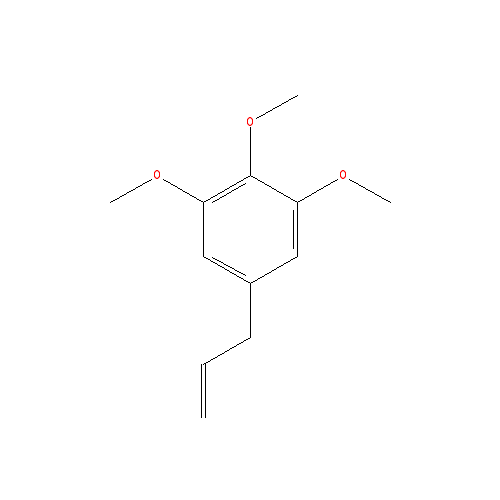
3,4,5-Trimethoxy-1-(2-propenyl)benzene
3,4,5-Trimethoxy-1-allylbenzene
化学組成 · Constituent
Elemicin là một phenylpropenoid liên quan đến myristicin, có khả năng góp phần vào tác dụng hướng thần của nhục đậu khấu. Council of Europe xếp loại nghi ngờ gây ung thư có khả năng gây độc gen.
Thần kinh. Elemicin có thể chịu một phần trách nhiệm cho tính ảo giác của nhục đậu khấu. Có lộ trình chuyển hoá lý thuyết để chuyển elemicin và myristicin thành TMA hoặc MMDA, những chất ảo giác đã biết. Tuy nhiên elemicin nguyên thể không đủ mạnh để giải thích tác động hướng thần của nhục đậu khấu.
Đột biến gen. Kết quả không nhất quán. Có nghiên cứu cho thấy elemicin chống đột biến, có nghiên cứu khác lại cho thấy mức độc gen từ thấp đến trung bình, hoặc đáng kể.
Ung thư. Trên chuột nhắt đực, elemicin không gây ung thư khi tiêm phúc mạc tổng liều 1.0 mg. Tuy nhiên chất chuyển hoá 10-hydroxyelemicin gây u gan ở liều cao. Chưa có nghiên cứu dài hạn trên chuột hoặc chuột cái.
Elemicin is a phenylpropenoid related to myristicin and may contribute to the psychotropic effects of nutmeg. The Council of Europe lists it as a suspected genotoxic carcinogen.
Neurology. Elemicin may be partially responsible for the hallucinogenic properties of nutmeg. A theoretical metabolic pathway can convert elemicin and myristicin to TMA or MMDA, both known hallucinogens. However, elemicin per se is insufficiently potent to explain the psychotropic effects of nutmeg.
Mutagenicity. Results are inconsistent. Some studies show elemicin to be antimutagenic, others suggest low to moderate or significant genotoxicity.
Cancer. In male mice, elemicin was not carcinogenic at a total ip dose of 1.0 mg. However, the metabolite 10-hydroxyelemicin produced hepatomas at higher doses. No long-term studies in rats or female mice are available.
| Nhựa Elemi · Elemi | 1.8 – 10.6 % |
| Ngò tây (hạt) · Parsley seed | 0 – 8.8 % |
| Nhục đậu khấu Đông Ấn · Nutmeg (East Indian) | 0.1 – 4.6 % |
| Vỏ nhục đậu khấu · Mace | 0.2 – 3.1 % |
| Cỏ xanh Phi · African bluegrass | 1.8 – 2.7 % |
| Thorow Wax (Bupleurum) · Thorow-wax | 2.0 % |
| Rễ rắn · Snakeroot | 0 – 1.8 % |
| Nhục đậu khấu Tây Ấn · Nutmeg (West Indian) | 1.2 – 1.4 % |
Elemicin trên chuột chuyển hoá qua hai con đường chính: oxi hoá thành axit 3-(3,4,5-trimethoxyphenyl)-propionic và 3-(3,4,5-trimethoxyphenyl)-propane-1,2-diol. Một lượng nhỏ epoxide của dẫn xuất 3-O-demethyl cũng được tạo thành. Sau khi ăn nhục đậu khấu, các chất chuyển hoá O-demethyl elemicin và O-demethyl dihydroxy elemicin xuất hiện trong nước tiểu người.
Elemicin in rats undergoes two main biotransformations: oxidation to 3-(3,4,5-trimethoxyphenyl)-propionic acid and 3-(3,4,5-trimethoxyphenyl)-propane-1,2-diol. Small amounts of the epoxide of the 3-O-demethylated derivative are also formed. After nutmeg ingestion, the metabolites O-demethyl elemicin and O-demethyl dihydroxy elemicin appear in human urine.
Elemicin cùng với myristicin và safrole là ba phenylpropenoid quan trọng trong nhục đậu khấu, đóng góp vào cả hương và hồ sơ độc lý của oil này.
Elemicin together with myristicin and safrole are the three major phenylpropenoids in nutmeg, contributing to both the aroma and the toxicology profile of the oil.