Coumarin
2H-1-Benzopyran-2-one
1,2-Benzopyrone · Tonka bean camphor
化学組成 · Constituent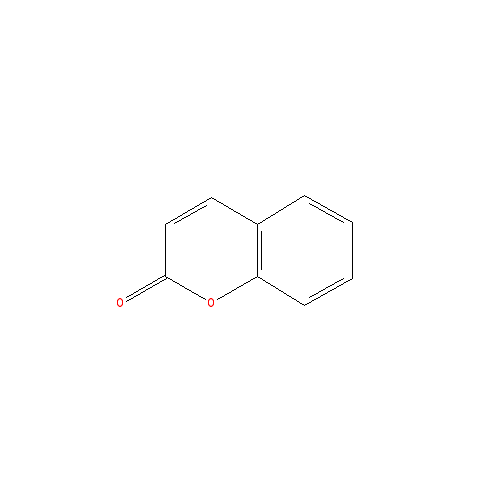
2H-1-Benzopyran-2-one
1,2-Benzopyrone · Tonka bean camphor
化学組成 · Constituent
Coumarin là lactone gây mùi cỏ khô đặc trưng. Hợp chất nằm trong danh sách 26 chất gây dị ứng EU và có rủi ro gan ở một nhóm người chuyển hoá kém.
Trên da. Patch test 8 phần trăm trên 25 tình nguyện không gây mẫn cảm. Trong 14.000 bệnh nhân viêm da, 58 (0.4 phần trăm) dương với 5–8 phần trăm. Tỷ lệ mẫn cảm trong dân số chung thấp.
Đường uống. LD50 cấp tính chuột 293 mg/kg, chuột nhắt 196 mg/kg. Liều tử vong người ước tính cao hơn nhiều do chuyển hoá khác biệt.
Gan. Coumarin gây độc gan ở loài gặm nhấm thông qua chất chuyển hoá 3,4-oxide. Ở người, đường chuyển hoá chính là 7-hydroxylation (79 phần trăm), tạo ít chất độc hơn. Tuy nhiên khoảng 1 phần trăm dân số có CYP2A6 biến thể, chuyển hoá kém 7-hydroxylation, dẫn đến tăng enzyme gan. Đã có báo cáo viêm gan tự phục hồi ở liều 90 mg/ngày trên 231 bệnh nhân Đức.
Tương tác thuốc. Coumarin ức chế monoamine oxidase trong não chuột với IC50 41.4 μM, gợi ý tương tác với MAOI và SSRI khi dùng đường uống.
Sinh sản. Hợp chất qua nhau và sữa, không có dữ liệu trực tiếp về tác hại trên người.
Ung thư. NTP xếp coumarin có bằng chứng rõ gây ung thư ở chuột nhắt cái và một số bằng chứng ở chuột đực. Tuy nhiên người chuyển hoá khác hẳn loài gặm nhấm, và đường ung thư ở chuột chưa được chứng minh ở người. Ý kiến chung là coumarin không phải chất gây ung thư ở người ở mức tiêu thụ thực tế.
Đột biến gen. Không gây đột biến trong Ames test. Bảo vệ chống tổn thương DNA trong một số thử nghiệm.
Coumarin is the lactone responsible for the new-mown hay aroma. Listed among the 26 EU fragrance allergens, the compound carries hepatic risk in a subset of poor metabolizers.
Skin. An 8 percent patch test on 25 volunteers caused no sensitization. Among 14,000 dermatitis patients, 58 (0.4 percent) reacted to 5–8 percent. Population sensitization rates are low.
Oral. Acute oral LD50 in rats is 293 mg/kg, in mice 196 mg/kg. The human fatal dose is estimated much higher due to different metabolism.
Liver. Coumarin is hepatotoxic in rodents through the 3,4-oxide metabolite. In humans the dominant pathway is 7-hydroxylation (79 percent), producing fewer toxic species. However about 1 percent of the population carries CYP2A6 variants that hydroxylate poorly, leading to elevated liver enzymes. Self-resolving hepatitis has been reported at 90 mg/day in a study of 231 German patients.
Drug interactions. Coumarin inhibits mouse brain monoamine oxidase with IC50 41.4 μM, suggesting interactions with MAOI and SSRI drugs when taken orally.
Reproductive. The compound crosses placenta and milk, with no direct human harm data.
Cancer. NTP classifies coumarin as having clear evidence of carcinogenicity in female mice and some evidence in males. However human metabolism differs markedly from rodents, and the rodent cancer pathway has not been demonstrated in humans. The general view is that coumarin is not a human carcinogen at realistic intake levels.
Mutagenicity. Non-mutagenic in the Ames test. Protective against DNA damage in some assays.
| Cỏ Sweet Vernal · Sweet vernalgrass | 46.8 – 68.0 % |
| Đậu Tonka · Tonka | 38.7 – 58.7 % |
| Lưỡi nai · Deertongue | < 25.0 % |
| Hoa oải hương · Lavender | 4.3 % |
| Lavandin | 3.0 % |
| Quế Cassia · Cassia | 0.03 – 2.5 % |
| Hoa thủy tiên · Narcissus | 0 – 1.2 % |
Coumarin được hấp thu nhanh qua da và đường uống, phân phối và bài tiết nhanh. Bán huỷ huyết tương sau bôi da khoảng 1.7 giờ ở người và 5 giờ ở chuột.
Ở người, chuyển hoá chính là 7-hydroxylation tạo 7-hydroxycoumarin (79 phần trăm). Ở chuột, đường 3,4-oxide chiếm ưu thế, sinh ra các chất chuyển hoá độc tiềm năng. Bị chuyển hoá lần đầu rộng tại gan.
Coumarin is rapidly absorbed through skin and gut, with rapid distribution and excretion. Plasma half-life after dermal application is about 1.7 hours in humans and 5 hours in rats.
In humans, the dominant pathway is 7-hydroxylation to 7-hydroxycoumarin (79 percent). In rodents, the 3,4-oxide route predominates, yielding potentially toxic metabolites. Extensive first-pass metabolism occurs in the liver.
Coumarin là cấu tử then chốt cho note hay trong lavender absolute và tonka. Hợp chất từng được dùng làm chất tạo hương thực phẩm nhưng đã bị giới hạn bởi FDA do quan ngại độc tính gan ở loài gặm nhấm.
Nồng độ cao trong hơi thuốc lá là một nguồn tiếp xúc đáng kể với coumarin trong dân số.
Coumarin is the key carrier of the hay note in lavender absolute and tonka. The compound was once used as a food flavoring but has been restricted by the FDA over rodent hepatotoxicity concerns.
High concentrations in tobacco smoke are a significant population exposure source.