Nootkatone
1,2,3,5,6,7,8,8a-Octahydro-1,8a-dimethyl-7-(1-methylethenyl)-naphthalene-3-one
1(10),11-Eremophiladien-2-one
化学組成 · Constituent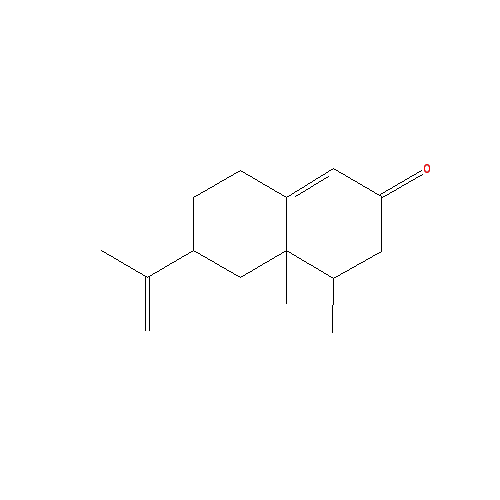
1,2,3,5,6,7,8,8a-Octahydro-1,8a-dimethyl-7-(1-methylethenyl)-naphthalene-3-one
1(10),11-Eremophiladien-2-one
化学組成 · Constituent
Nootkatone is a sesquiterpenoid ketone that gives grapefruit its characteristic aroma. The compound is safe in high purity form, but less pure samples may cause sensitization.
Skin. Nootkatone caused no irritation at 10 percent on three groups of 25, 25 and 28 volunteers. An 86 percent pure sample elicited one sensitization reaction on 25 volunteers. Another 86 percent sample at 10 percent elicited three sensitization reactions on 28 male volunteers. A 98 percent pure sample caused no sensitization.
When 1 part nootkatone is mixed with 4 parts limonene, sensitization activity is counteracted. Grapefruit oil (approximately 90 percent limonene) and bergamot (27 to 52 percent limonene) are typically safe through this ratio.
Acute toxicity. Acute oral LD50 in rats exceeded 5 g/kg. Acute dermal LD50 in rabbits exceeded 5 g/kg.
| Grapefruit | 0.1 – 0.8 % |
| Bergamot | 0.01 – 0.1 % |
The metabolic pathway of nootkatone in rabbits goes via epoxidation of the isopropenyl group followed by hydration. Six male rabbits with an average body weight of 2.5 kg given 2 g of nootkatone orally produced two urinary metabolites: (+)-nootkatone-13,14-diol (the major metabolite at approximately 35 percent of neutral metabolites) and (+)-nootkatone-13,14-diol monoacetate.
Nootkatone has been studied as a natural insect repellent, particularly against ticks and mosquitoes. The US EPA has approved nootkatone as a biological pesticide.