Methoxsalen
9-Methoxy-7H-furo[3,2-g][1]benzopyran-7-one
8-Methoxypsoralen · 8-MOP · Xanthotoxin · Ammoidin
化学組成 · Constituent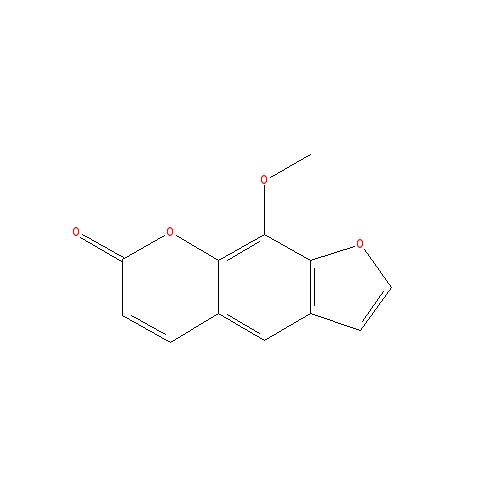
9-Methoxy-7H-furo[3,2-g][1]benzopyran-7-one
8-Methoxypsoralen · 8-MOP · Xanthotoxin · Ammoidin
化学組成 · Constituent
Methoxsalen is a furanocoumarin present at very low levels in rue and expressed lime. The compound is phototoxic and photocarcinogenic to humans, classed by IARC as carcinogenic to humans when combined with UVA radiation.
Skin. Methoxsalen is phototoxic and potentially photocarcinogenic. PUVA therapy (psoralen plus UVA) for psoriasis carries long-term skin cancer risk.
Subacute and chronic toxicity. Oral dosing in rats for up to 90 days caused hepatotoxicity at 50 mg/kg/day and above, with atrophy of testes and prostate in males. Rat 90-day NOAEL is 25 mg/kg. Two-year oral dosing caused kidney damage, thyroid hypertrophy and carcinomas.
Reproductive. Pregnant rats fed 1,250 or 2,500 ppm showed decreased weight gain, fewer pups and reduced uterine weight. Developmental toxicity NOAEL was 80 mg/kg, maternal toxicity NOAEL 20 mg/kg. Methoxsalen reduces 17β-estradiol levels and induces CYP1A1 and UGT1A6.
Immune system. PUVA therapy causes mild immunosuppression including reduced delayed-type hypersensitivity and small reductions in circulating T lymphocyte number.
Mutagenicity and cancer. Methoxsalen was photomutagenic in S. typhimurium and genotoxic in human lymphocytes in the presence of UVA. In follow-up of 1,380 psoriasis patients, squamous cell carcinoma incidence rose from 4.1 percent for low-dose PUVA to 56.8 percent for high-dose.
| Rue | 0.032 % |
| Lime (expressed) | < 0.0005 % |
| Parsnip | Trace |
Methoxsalen undergoes extensive first-pass metabolism in the liver before entering general circulation. Uptake into human skin is proportional to concentration and time, increasing with vehicle polarity. No metabolic changes were detected in the skin for up to 16.7 hours.
Methoxsalen inhibits CYP1A1, CYP2B1 and CYP3A. It inhibits CYP3A4 with IC50 values of 35 to 39 µM in two different human livers.
Methoxsalen is one of the most studied furanocoumarins due to its medical use in psoriasis and cutaneous lymphoma. In essential oils, the compound occurs at levels too low for acute toxicity, but it adds to the combined phototoxicity of other furanocoumarins.