Vanillin
3-Methoxy-4-hydroxybenzaldehyde
Vanillic aldehyde · Methylprotocatechuic aldehyde
化学組成 · Constituent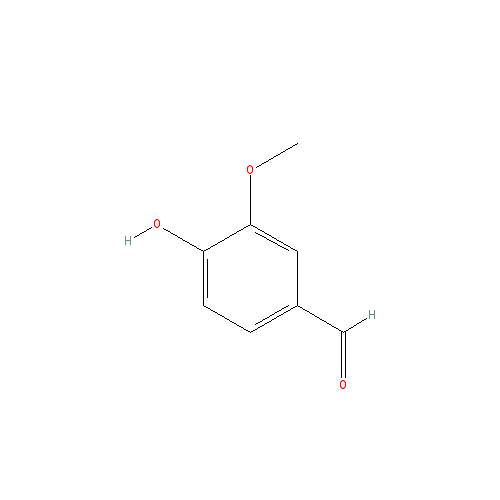
3-Methoxy-4-hydroxybenzaldehyde
Vanillic aldehyde · Methylprotocatechuic aldehyde
化学組成 · Constituent
Vanillin là cấu tử chính của vanilla, đạt 12 đến 95 phần trăm tuỳ chất lượng. Vanillin tồn tại dưới dạng glycoside trong vanilla, giải phóng khi ủ. Là phenol thế nên có tính axit yếu. Dữ liệu cho thấy hợp chất an toàn ở nồng độ thông thường.
Trên da. Không gây kích ứng ở 2 phần trăm trên 30 tình nguyện, 20 phần trăm trên 29 tình nguyện hoặc 0.4 phần trăm trên 35 bệnh nhân viêm da. Trên 70 bệnh nhân viêm da tiếp xúc ở 10 phần trăm không phản ứng. Ở 2 hoặc 5 phần trăm trên 25 tình nguyện không gây mẫn cảm. Một số người nhạy cảm với Peru balsam có phản ứng chéo nhẹ. Không gây độc ánh sáng.
Đường uống. LD50 cấp tính trên chuột 1.4 đến 2.8 g/kg, trên chuột lang 1.4 g/kg. LD50 phúc mạc 480 đến 1.190 mg/kg tuỳ loài. LD50 dưới da trên chuột 1.5 đến 2.6 g/kg.
Bán mãn tính và mãn tính. Cho chuột uống 530 mg/kg/ngày trong 4 ngày không có tổn thương gan. Cho chuột nhắt ăn 3.000 ppm trong 91 ngày không có tác dụng phụ. Ở 10.000 ppm có tác dụng nhẹ. Ở 50.000 ppm chậm tăng trưởng và phì đại gan, thận, lách. Cho chuột ăn từ 1.000 đến 50.000 ppm trong tối đa hai năm không có tác dụng phụ ở mọi liều dưới 50.000 ppm.
Sinh sản. Trong assay ex vivo, vanillin không liên kết với thụ thể estrogen trong mô tử cung chuột cái.
Đột biến gen. Không gây đột biến trong nhiều Ames test và rec assay. Antimutagenic trong tế bào động vật in vitro và in vivo. Giảm CA do tia X gây ra ở tuỷ xương chuột và do methotrexate ở tế bào phổi hamster.
Ung thư. Tiêm phúc mạc cho chuột nhắt tổng liều 3.6 hoặc 18 g/kg trong 24 tuần không tăng u phổi nguyên phát. Vanillin ức chế sinh ung thư gan ở chuột và hoạt hoá nitrosamine sinh ung thư trong microsome gan và phổi chuột nhắt.
Vanillin is the principal constituent of vanilla at 12 to 95 percent depending on quality. Vanillin occurs as a glycoside in vanilla and is released by enzymatic cleavage on curing. As a substituted phenol it has weak acid activity. Available data indicates it is safe at standard concentrations.
Skin. Non-irritating at 2 percent on 30 volunteers, 20 percent on 29 volunteers and 0.4 percent on 35 dermatitis patients. In 70 contact dermatitis patients at 10 percent no reactions occurred. At 2 or 5 percent on 25 volunteers it was non-sensitizing. Some Peru balsam-sensitive individuals show mild cross-reactivity. Non-phototoxic.
Oral. Acute oral LD50 in rats was 1.4 to 2.8 g/kg and in guinea pigs 1.4 g/kg. Intraperitoneal LD50 was 480 to 1,190 mg/kg depending on species. Subcutaneous LD50 in rats was 1.5 to 2.6 g/kg.
Subchronic and chronic. Rats given 530 mg/kg/day for 4 days showed no liver lesions. Mice fed 3,000 ppm for 91 days showed no adverse effects. At 10,000 ppm mild effects appeared. At 50,000 ppm growth retardation and enlargement of liver, kidneys and spleen occurred. Rats fed 1,000 to 50,000 ppm for up to two years showed no adverse effects at any dose below 50,000 ppm.
Reproductive. In an ex vivo assay, vanillin did not bind to estrogen receptors in female rat uterus tissue.
Mutagenicity. Not mutagenic in multiple Ames tests and rec assays. Antimutagenic in animal cells in vitro and in vivo. Reduced X-ray induced CA in mouse bone marrow and methotrexate-induced CA in hamster lung cells.
Cancer. Intraperitoneal mouse studies with total doses of 3.6 or 18 g/kg over 24 weeks did not increase primary lung tumors. Vanillin inhibited hepatic carcinogenesis in rats and inhibited carcinogenic nitrosamine activation in mouse hepatic and pulmonary microsomes.
| Vani · Vanilla | 12.0 – 95.0 % |
| Nhựa Tolu · Tolu balsam | 1.4 % |
Vanillin được oxi hoá thành axit vanillic hoặc khử thành vanillyl alcohol. Ở thỏ, 69 phần trăm liều uống thải dưới dạng axit vanillic, hoặc tự do 44 phần trăm hoặc liên hợp 25 phần trăm. Ở chuột, một nghiên cứu cho thấy 17 phần trăm tự do và 24 phần trăm liên hợp. Ở người, 73 phần trăm là axit vanillic, 2 phần trăm là vanillin không chuyển hoá.
Vanillin là chất ức chế mạnh các enzyme sulfotransferase liên quan đến chuyển hoá thuốc phenolic, và có thể là chất cảm ứng enzyme chuyển hoá thuốc microsome.
Vanillin can be oxidized to vanillic acid or reduced to vanillyl alcohol. In rabbits, 69 percent of an oral dose was excreted as vanillic acid, either free at 44 percent or conjugated at 25 percent. In rats, one study reported 17 percent free and 24 percent conjugated. In humans, 73 percent of vanillic acid was found in urine, with 2 percent of unchanged vanillin.
Vanillin is a potent inhibitor of sulfotransferase enzymes involved in phenolic drug metabolism, and may also induce microsomal drug-metabolizing enzymes.
Vanillin tổng hợp được sản xuất với khối lượng rất lớn cho ngành hương liệu thực phẩm và mỹ phẩm, từ guaiacol hoặc lignin. Vanillin có hoạt tính chống đột biến qua cơ chế tăng cường sửa chữa tái tổ hợp DNA.
Vanilla absolute thường được dùng trong nước hoa và mỹ phẩm cao cấp với nồng độ rất thấp. IFRA năm 2009 đặt giới hạn 0.5 phần trăm cho vanillin trong sản phẩm leave-on nhưng sau đó đã thu hồi để xem xét lại.
Synthetic vanillin is produced at very large scale for food and cosmetic flavoring, from guaiacol or lignin. Vanillin shows antimutagenic activity by enhancing recombinational DNA repair.
Vanilla absolute is used in fine fragrance and luxury cosmetics at very low concentrations. IFRA set a 0.5 percent limit for vanillin in leave-on products in 2009 but later withdrew the standard pending data review.