Diallyl sulfide
Di-(2-propenyl) sulfide
Allyl sulfide · Thioallyl ether
化学組成 · Constituent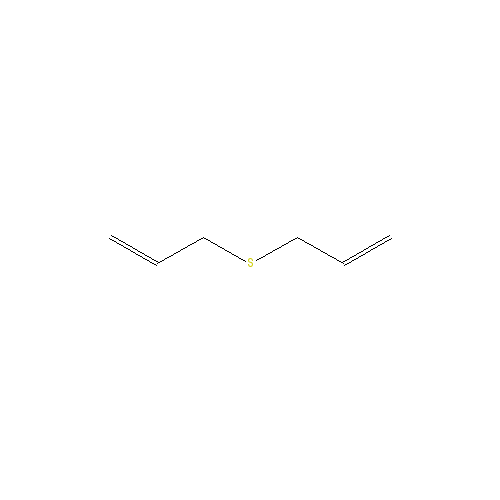
Di-(2-propenyl) sulfide
Allyl sulfide · Thioallyl ether
化学組成 · Constituent
Diallyl sulfide xuất hiện ở mức thấp trong tinh dầu tỏi và mù tạt. Ít độc hơn diallyl disulfide và có hoạt tính bảo vệ rõ rệt.
Trên da. Patch test ở 0.5 phần trăm trên 22 tình nguyện viên không gây kích ứng cũng không gây mẫn cảm. Nguyên chất cực kỳ kích ứng da thỏ. Ở bệnh nhân dị ứng tỏi, không gây phản ứng mẫn cảm.
Đường uống. LD50 cấp tính trên chuột nhắt 2.03 g/kg (đực) và 1.81 g/kg (cái), trên chuột 2.98 g/kg. LD50 qua da trên thỏ vượt 5 g/kg.
Mạch máu. Ức chế kết tập tiểu cầu mạnh in vitro.
Gan. Bảo vệ gan khỏi độc tính của paracetamol và aflatoxin B1. Ít gây độc tế bào gan hơn diallyl disulfide.
Ung thư. Có hoạt tính chống ung thư đáng kể trên nhiều mô hình động vật, bao gồm ung thư đại tràng, phổi, da, thực quản, gan và vú.
Diallyl sulfide occurs at low levels in garlic and mustard oils. It is less toxic than diallyl disulfide and shows pronounced protective activity.
Skin. A 0.5 percent patch test on 22 volunteers produced no irritation or sensitization. Undiluted, it was extremely irritating to rabbit skin. In garlic-sensitive patients it caused no sensitization reactions.
Oral. Acute oral LD50 in mice is 2.03 g/kg (male) and 1.81 g/kg (female), in rats 2.98 g/kg. Acute dermal LD50 in rabbits exceeds 5 g/kg.
Cardiovascular. Strong antiplatelet aggregation activity in vitro.
Liver. Protects against paracetamol- and aflatoxin B1-induced liver toxicity. Much less cytotoxic to hepatocytes than diallyl disulfide.
Cancer. Significant chemopreventive activity across multiple animal models, including colon, lung, skin, esophageal, liver and breast cancers.
| Mù tạt · Mustard | 0 – 5.5 % |
| Tỏi · Garlic | 1.1 – 2.4 % |
Diallyl sulfide chuyển hoá chính thành allyl methyl sulfide trong tế bào gan chuột. Hợp chất cảm ứng các enzyme giải độc giai đoạn II như quinone reductase và glutathione S-transferase.
Diallyl sulfide is mainly metabolized to allyl methyl sulfide in rat hepatocytes. The compound induces phase II detoxifying enzymes such as quinone reductase and glutathione S-transferase.
Diallyl sulfide có hoạt tính bảo vệ rõ rệt hơn diallyl disulfide, vừa bảo vệ gan vừa chống ung thư, mà không gây độc tế bào gan đáng kể.
Diallyl sulfide shows more pronounced protective activity than diallyl disulfide, being both hepatoprotective and chemopreventive without significant hepatocyte toxicity.