Allyl isothiocyanate
3-Isothiocyanato-1-propene
Allyl isosulfocyanate
化学組成 · Constituent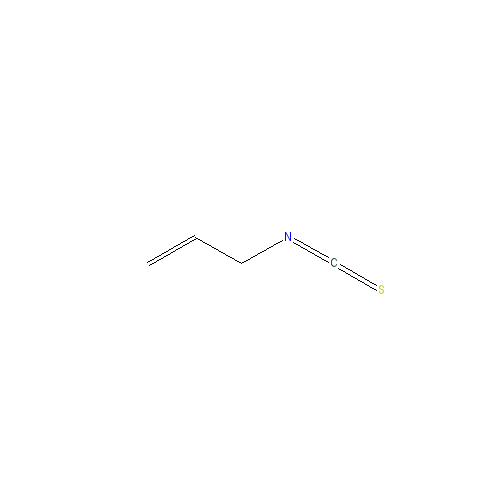
3-Isothiocyanato-1-propene
Allyl isosulfocyanate
化学組成 · Constituent
Allyl isothiocyanate là chất kích ứng nặng cho niêm mạc và da. IFRA và Liên minh Châu Âu cấm hoàn toàn trong sản phẩm hương liệu và mỹ phẩm.
Trên da. Chỉ 2 trên 259 bệnh nhân viêm da nghi ngờ dị ứng tiếp xúc do rau quả có phản ứng dương tính khi patch test với mù tạt. Tuy nhiên mức kích ứng cao của hợp chất khiến nó không phù hợp cho sản phẩm bôi ngoài da.
Đường uống. LD50 cấp tính trên chuột dao động 340 đến 490 mg/kg, mức trung bình. Cho chuột ăn 50 mg/kg trong 20 ngày gây loét dạ dày toàn bộ. Ở 20 mg/kg, một nửa số chuột bị loét.
Sinh sản. Tiêm dưới da 50 mg/kg trong hai ngày liên tiếp gây chết phôi và giảm trọng lượng thai ở chuột đang mang thai.
Gan. Allyl isothiocyanate và các chất chuyển hoá glutathione và N-acetylcysteine của nó độc đáng kể với tế bào gan chuột.
Ung thư. Trong nghiên cứu hai năm, cho chuột đực ăn 12 hoặc 25 mg/kg năm lần một tuần gây u nhú bàng quang. Ở chuột cái có dấu hiệu mơ hồ của u xơ dưới da.
Allyl isothiocyanate is a severe irritant to mucous membranes and skin. IFRA and the European Union prohibit it entirely in fragrance and cosmetic products.
Skin. Only 2 of 259 dermatitis patients with suspected contact allergy from vegetables and food reacted positively when patch-tested with mustard. The compound's high irritancy disqualifies it from topical use.
Oral. Acute oral LD50 in rats ranges from 340 to 490 mg/kg, a moderate level. Rats fed 50 mg/kg for 20 days developed acute to subacute stomach ulceration in all animals. At 20 mg/kg, half developed ulceration.
Reproductive. Subcutaneous injection of 50 mg/kg for two consecutive days caused embryonic death and decreased fetal weight in pregnant rats.
Liver. Allyl isothiocyanate and its glutathione and N-acetylcysteine conjugates are considerably toxic to rat liver cells.
Carcinogenic. In a two-year study, male rats fed 12 or 25 mg/kg five times a week developed papillomas in the urinary bladder. Female rats showed equivocal evidence of subcutaneous fibrosarcomas.
| Cải ngựa · Horseradish | 44.3 – 55.7 % |
| Mù tạt · Mustard | 23.2 – 68.8 % |
Allyl isothiocyanate được chuyển hoá thành các mercapturic acid và kết hợp với N-acetylcysteine. Trong chuột và chuột nhắt, hơn 80 phần trăm liều uống được bài tiết qua nước tiểu trong vòng 48 giờ dưới dạng N-acetyl-S-(N-allylthiocarbamoyl)-L-cysteine.
Hợp chất hoạt động cũng tìm thấy trong rau cải họ Brassicaceae như bắp cải và súp lơ xanh, nhưng ở nồng độ thấp hơn nhiều so với tinh dầu mù tạt.
Allyl isothiocyanate is metabolized to mercapturic acids and conjugated with N-acetylcysteine. In rats and mice, over 80 percent of an oral dose is excreted in urine within 48 hours as N-acetyl-S-(N-allylthiocarbamoyl)-L-cysteine.
The active compound is also found in Brassicaceae vegetables such as cabbage and broccoli, at much lower concentrations than in mustard essential oil.
Allyl isothiocyanate là thành phần định nghĩa mùi và độ cay của mù tạt, cải ngựa, và wasabi.
Ở dạng nồng độ thấp, hợp chất được dùng làm chất tạo hương trong thực phẩm với giới hạn ADI rất nhỏ.
Nghiên cứu nhóm ECETOC xếp allyl isothiocyanate vào nhóm gây dị ứng mức trung bình, có thể gây phản ứng mẫn cảm nếu hiện diện từ 1 phần trăm trở lên trong sản phẩm.
Allyl isothiocyanate is the compound that defines the pungency and aroma of mustard, horseradish and wasabi.
At low concentrations the compound is used as a food flavoring with a very small ADI limit.
An ECETOC group review classified allyl isothiocyanate as a moderate allergen, likely to elicit sensitization reactions at 1 percent or more in a product.