Thujaplicin
2-Hydroxy-4-(1-methylethyl)-2,4,6-cycloheptatrien-1-one
Hinokitiol · β-Thujaplicin · 4-Isopropyltropolone
化学組成 · Constituent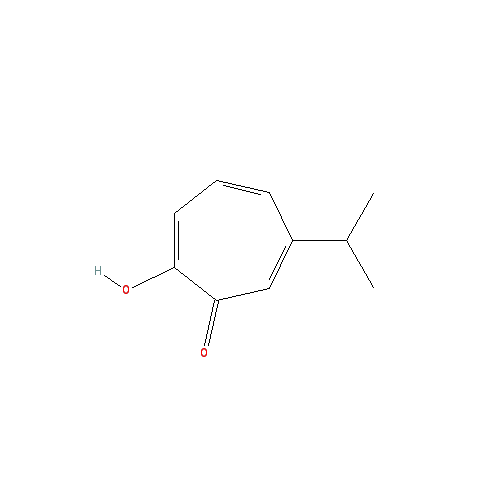
2-Hydroxy-4-(1-methylethyl)-2,4,6-cycloheptatrien-1-one
Hinokitiol · β-Thujaplicin · 4-Isopropyltropolone
化学組成 · Constituent
Thujaplicin exists as α, β and γ isomers. β-Thujaplicin, also called hinokitiol, is the principal constituent of hibawood oil. Approved as a natural food preservative in Japan since 1996.
Skin. β-Thujaplicin has been reported as a cause of allergic contact dermatitis.
Oral. Mouse acute oral LD50 of β-thujaplicin was 775 mg/kg. Mouse intraperitoneal LD50 values were 256 mg/kg for α, 191 mg/kg for β, and 277 mg/kg for γ-thujaplicin.
Subchronic. Rats fed β-thujaplicin at 0.02, 0.07 and 0.2 percent for 13 weeks. The rat NOAEL was 0.02 percent, equivalent to 12.7 mg/kg/day for males and 14.8 mg/kg/day for females.
Reproductive. A single oral dose of 420 to 1,000 mg/kg β-thujaplicin in pregnant mice was teratogenic at the three highest doses. The ED1 for external malformations was 190 mg/kg. Pregnant rats given 15, 45 or 135 mg/kg by gavage on gestational days 6 to 15. At 135 mg/kg there was a significant increase in postimplantation loss and malformations. The maternal and fetal NOAEL was 15 mg/kg.
Mutagenicity. Not mutagenic in the Ames test, but mutagenic in a rec assay with S9 and in a CA test. Not genotoxic in a mouse micronucleus assay.
Chronic. Rats fed β-thujaplicin at 0.015 or 0.05 percent for two years, equivalent to 6.4 to 25.9 mg/kg/day, showed no increased neoplastic lesions in 16 organs.
| Hibawood | Major constituent |
β-Thujaplicin has a relatively short half-life in the body and is considered unlikely to accumulate in humans. The compound is used in Japan as a natural preservative for food and cosmetics. There are significant interspecies differences in reproductive tolerance between rats and mice.