Piperonal
3,4-Methylenedioxybenzaldehyde
Piperonaldehyde · Heliotropin · Geliotropin
化学組成 · Constituent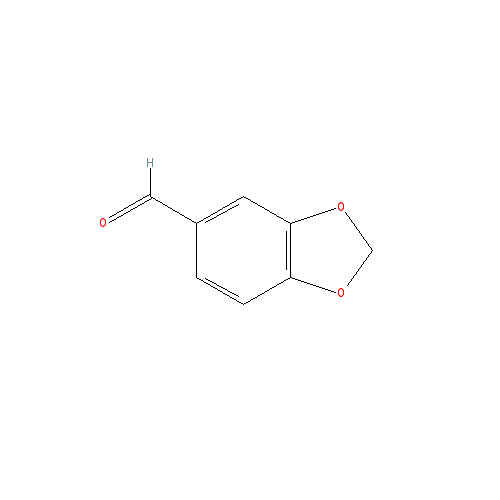
3,4-Methylenedioxybenzaldehyde
Piperonaldehyde · Heliotropin · Geliotropin
化学組成 · Constituent
Piperonal is a trace constituent of vanilla and some flower oils. It is safe at standard concentrations but is monitored by the FDA as a precursor chemical.
Skin. A 24-hour patch test with undiluted material caused one irritation reaction in 20 volunteers. At 6 percent it was not sensitizing on 25 volunteers. At 5 percent it caused allergic reactions in 6 of 1,606 dermatitis patients, a rate of 0.4 percent. At 1 percent the rate dropped to 0.1 percent.
Oral. Acute oral LD50 in rats was 2.7 g/kg. Rats fed 1,000 ppm for 28 weeks and 10,000 ppm for 15 weeks showed no adverse effects. Rats fed 0.1 or 0.5 percent for two years showed no adverse effects.
Mutagenicity. Not mutagenic in the Ames test. Inconsistent results in Bacillus subtilis DNA rec assays.
| Vanilla | Trace |
After oral administration in rabbits, about 28 percent of the dose was recovered in urine as piperonylic acid. In mice, 89 percent of an oral dose was recovered, mainly as piperonylglycine. In rats, 93 percent was recovered within 24 hours, with 71 percent as piperonylglycine and 20 percent as piperonylic acid.
Piperonal is widely used in perfumery for its heliotrope note and was one of the earliest synthetic compounds of modern perfumery.