Perillyl alcohol
4-(1-Methylethenyl)-1-cyclohexene-1-methanol
Perilla alcohol · Perillic alcohol · p-Mentha-1,8-dien-7-ol · Isocarveol
化学組成 · Constituent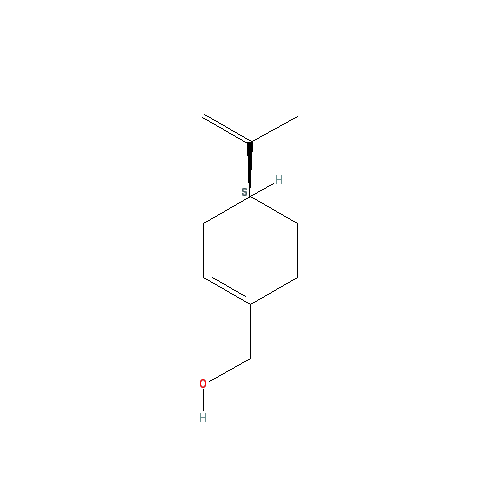
4-(1-Methylethenyl)-1-cyclohexene-1-methanol
Perilla alcohol · Perillic alcohol · p-Mentha-1,8-dien-7-ol · Isocarveol
化学組成 · Constituent
Perillyl alcohol is a metabolite of limonene and occurs at small levels in perilla oil. It is safe for topical use. At high oral doses used in clinical research it causes nausea and fatigue.
Skin. Patch testing 25 volunteers with 4 percent showed neither irritation nor sensitization. In a phase 1 trial for skin cancer, 0.76 percent applied twice daily for 30 days produced no cutaneous or systemic toxicity in 25 subjects.
Oral. Acute oral LD50 in rats was 2.1 g/kg. Acute dermal LD50 in rabbits exceeded 5 g/kg. The 6-week dietary MTD in rats was 2.5 g/kg.
Human toxicity. Across multiple phase 1 and 2 clinical trials, oral doses of 1,200 to 8,400 mg/m2 per day, equivalent to 31 to 218 mg/kg, caused nausea, vomiting, fatigue and gastrointestinal distress in most patients, often limiting the therapeutic dose.
Cardiovascular and respiratory. In an intranasal trial of 55 mg four times daily for 6 months in brain cancer patients, no clinical signs of toxicity were observed. Hematological and biochemical parameters remained normal.
| Perilla | 5.4 % |
Perillyl alcohol, like limonene, is rapidly metabolized to perillic acid, dihydroperillic acid and small amounts of their methyl esters in both rats and humans. Both (Z) and (E) isomers of dihydroperillic acid are found in equal amounts, along with a small amount of unchanged perillyl alcohol.
Perillaldehyde is a major intermediary metabolite in this pathway.
Perillyl alcohol has been extensively studied as a chemopreventive agent. It induces apoptosis in numerous cancer cell lines and inhibits tumor growth in mouse models of breast, colon, lung, skin and brain cancer.
It is often cited anecdotally as a lavender oil constituent, though current compositional analyses do not confirm this presence.