Perillaldehyde
4-(1-Methylethenyl)-1-cyclohexene-1-carboxaldehyde
Perilla aldehyde · Perillyl aldehyde · p-Mentha-1,8-dien-7-al
化学組成 · Constituent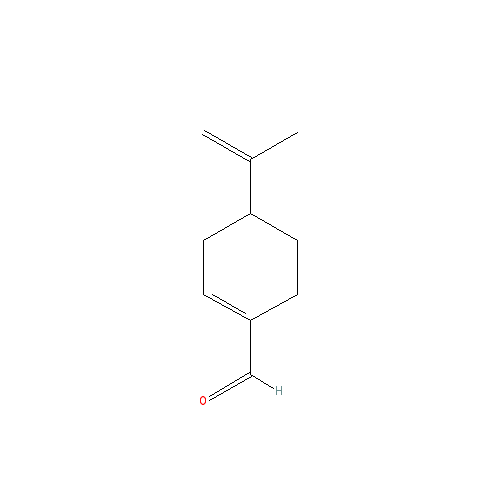
4-(1-Methylethenyl)-1-cyclohexene-1-carboxaldehyde
Perilla aldehyde · Perillyl aldehyde · p-Mentha-1,8-dien-7-al
化学組成 · Constituent
Perillaldehyde is the principal constituent of perilla oil from the perillaldehyde chemotype, reaching about 87 percent. It is safe for topical use at standard concentrations, with mild sensitization potential that has prompted an IFRA limit.
Skin. Patch tests at 1 and 4 percent on three separate volunteer panels were non-irritating. A maximation test at 4 percent gave 2 of 29 sensitization reactions. At 1 percent there were no reactions in 25 subjects.
Oral. Acute oral LD50 in mice was 1.72 g/kg. Acute dermal LD50 in guinea pigs exceeded 5 g/kg.
Mutagenicity. Results are inconsistent. Perillaldehyde was not mutagenic in the Ames test but produced chromosome aberrations in Chinese hamster fibroblasts. It was not genotoxic in mouse micronucleus tests.
Anticancer activity. Perillaldehyde inhibits proliferation of mouse B16 melanoma and several human cancer cell lines, and induces apoptosis.
| Perilla | 86.8 % |
The urine of rabbits orally dosed with 0.7 to 0.8 g/kg perillaldehyde contained mainly carboxylic acids including perillic acid, resulting from oxidation. Traces of aromatic acids such as cumic acid and small amounts of alcoholic reduction products were also detected.
Perillaldehyde shows antioxidant activity through activation of the antioxidant responsive element ARE.
The (S)- isomer is the form found in perilla oil and is a recognized sweetening agent in Japan, around 2,000 times sweeter than sucrose.