Benzyl cinnamate
Phenylmethyl 3-phenylprop-2-enoate
Cinnamic acid benzyl ester · Cinnamein (trans)
化学組成 · Constituent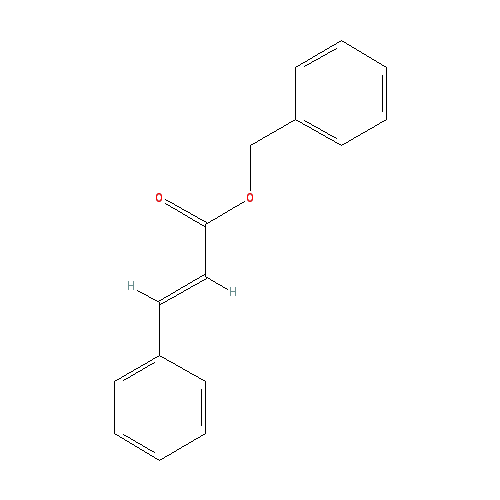
Phenylmethyl 3-phenylprop-2-enoate
Cinnamic acid benzyl ester · Cinnamein (trans)
化学組成 · Constituent
Benzyl cinnamate appears chiefly in Peru balsam and styrax. Practical data indicate very low irritation and sensitization risk; some authors consider its inclusion among the 26 EU fragrance allergens overcautious.
Skin. An 8 percent patch test on 25 volunteers caused neither irritation nor sensitization. An HRIPT at 4 percent on 101 volunteers gave no reactions. Among 1,072 dermatitis patients, under 1 percent reacted at 1–2 percent.
Peru balsam sensitive patients may cross-react: 3 of 102 reacted to 2 percent benzyl cinnamate.
Oral. Acute oral LD50 is 3.76 g/kg in guinea pigs and 3.28 g/kg in rats. Rabbit dermal LD50 exceeds 3 g/kg.
Subchronic. Rats fed 10,000 ppm for 19 weeks showed no macroscopic effects. NOAEL is 500 mg/kg/day.
Mutagenicity. Non-mutagenic in the Bacillus subtilis rec assay.
| Peru balsam | 0.4 – 30.1 % |
| Styrax | 1.7 % |
The source oils for benzyl cinnamate are Peru balsam and styrax, which themselves carry dermal limits. Adding a constituent-specific limit may be redundant.