β-Asarone
(Z)-2,4,5-Trimethoxy-1-(1-propenyl)benzene
(Z)-Asarone · cis-Asarone
化学組成 · Constituent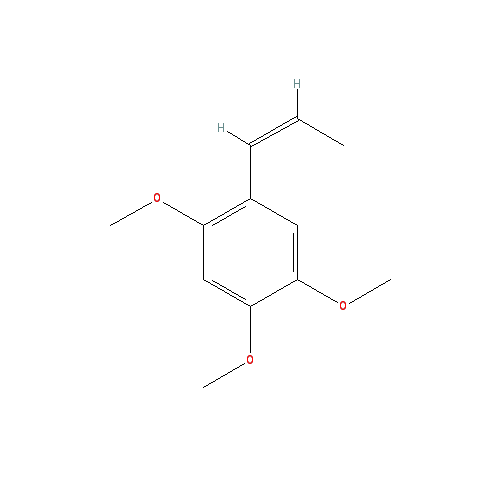
(Z)-2,4,5-Trimethoxy-1-(1-propenyl)benzene
(Z)-Asarone · cis-Asarone
化学組成 · Constituent
β-Asarone is the dominant constituent of tetraploid calamus oil (up to 78 percent) and triploid calamus (8–19 percent). The Council of Europe lists it under substances suspected to be genotoxic carcinogens for which no MDI can be set.
Acute toxicity. Acute oral LD50 in rats is 1,010 mg/kg, acute intraperitoneal 122 mg/kg.
Neurological. Intraperitoneal 25 mg/kg in rats prolonged electroshock seizures. At 100–200 mg/kg generalized seizures occurred; above 170 mg/kg severe clonic seizures appeared.
Cardiovascular. Intravenous 3 mg/kg dropped blood pressure by 50 mmHg in anesthetized dogs, recovering within 45 minutes.
Carcinogenicity. Four pre-weaning intraperitoneal injections produced malignant liver tumors in mice. In a two-year dietary study at 400, 800 or 2,000 ppm, no high-dose rats survived past 84 weeks; dose-dependent malignant leiomyosarcomas appeared in the small intestine of male rats.
Rat carcinogenicity NOAEL is 20 mg/kg. With a 10-fold interspecies and 20-fold inter-individual safety factor, the daily safe dose is 0.1 mg/kg, equivalent to a 0.22 percent dermal maximum.
| Calamus (tetraploid form) | 42.5 – 78.4 % |
| Calamus (triploid form) | 8.0 – 19.0 % |
The major metabolite of β-asarone in rat hepatocytes is 2,4,5-trimethoxycinnamic acid. Epoxide formation has also been proposed. Serum half-life after oral dosing in rats is 54 minutes, with peak serum concentration of 3.2 mg/L at 12 minutes.
Unlike estragole, methyleugenol and safrole, which target the liver on oral dosing, β-asarone is a propenylbenzene with a different metabolic profile; its oral carcinogenicity mechanism remains incompletely understood.
On several human colon cancer cell lines, β-asarone inhibits growth and induces apoptosis at doses as low as 10–100 nM. This dual activity is characteristic of phenylpropenoid compounds.
Oral use of calamus oil is not recommended under any circumstances.