Apiole (parsley)
1-(2-Propenyl)-2,5-dimethoxy-3,4-methylenedioxybenzene
Parsley apiol · Parsley camphor · Apioline
化学組成 · Constituent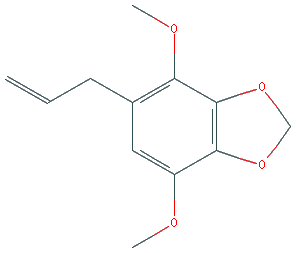
1-(2-Propenyl)-2,5-dimethoxy-3,4-methylenedioxybenzene
Parsley apiol · Parsley camphor · Apioline
化学組成 · Constituent
Parsley apiole is hepatotoxic, nephrotoxic and cardiotoxic at high doses. Historically used to induce illegal abortion, the compound has a record of fatal poisoning in humans.
Oral. The lowest fatal cumulative dose in adults is 4.2 g (2.1 g/day for two days). The lowest single fatal dose is 8 g. Poisoning symptoms include fever, severe abdominal pain, vaginal bleeding, vomiting and diarrhea. Autopsies typically show severe damage to liver, kidneys, gastrointestinal tract and sometimes heart tissue.
Reproductive. The lowest abortifacient daily dose is 900 mg over eight consecutive days. In a five-case series of women 2–7 months pregnant, one aborted and died, one did not abort but died, three aborted and survived. The compound has a cumulative effect.
Liver. A single oral 10 mL/kg dose killed all 12 mice within 60 hours, with gross and microscopic damage to liver and kidney.
Human toxicity is estimated to be similar to pulegone. Recommended daily oral maximum is 0.4 mg/kg, equivalent to 28 mg for an adult, corresponding to a maximum dermal level of 0.76 percent.
| Parsley seed | 11.3 – 67.5 % |
Parsley apiole metabolism involves extensive oxidation in both rabbits and dogs. In one poisoning case, apiole was still detectable in urine 12 days after the last ingestion, indicating slow elimination.
Parsley apiole is decomposition-sensitive in storage. The compound binds DNA only weakly and is not associated with tumor development.
Animal toxicity is far lower than human toxicity, highlighting the limits of rodent-to-human extrapolation in this case.