Thymoquinone
2-Methyl-5-(1-methylethyl)-2,5-cyclohexadien-1,4-dione
2-Isopropyl-5-methyl-1,4-benzoquinone · p-Mentha-3,6-dien-2,5-dione
化学組成 · Constituent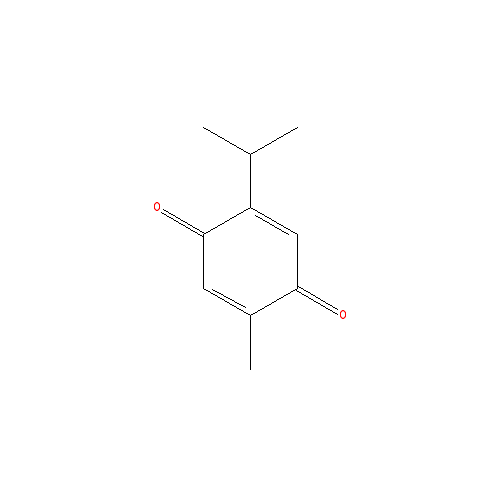
2-Methyl-5-(1-methylethyl)-2,5-cyclohexadien-1,4-dione
2-Isopropyl-5-methyl-1,4-benzoquinone · p-Mentha-3,6-dien-2,5-dione
化学組成 · Constituent
Thymoquinone là cấu tử chủ đạo của tinh dầu black seed, đạt 27 đến 55 phần trăm. Là quinone phản ứng, dễ tấn công bởi nucleophile như amino và thiol. Gây mẫn cảm da mạnh và độc sinh sản.
Trên da. Thymoquinone 1 phần trăm trong cồn được dùng làm chất kích ứng tham chiếu trong patch test cho 600 người eczema và 33 đối chứng khoẻ. Phản ứng dương tính ban đỏ tại chỗ ở 53 đến 63 phần trăm cả ba nhóm. Hợp chất là chất gây mẫn cảm tiếp xúc đáng kể.
Đường uống. LD50 cấp tính trên chuột 794 mg/kg và trên chuột nhắt 871 mg/kg. LD50 phúc mạc trên chuột 57.5 mg/kg, trên chuột nhắt 90 đến 105 mg/kg. Đường tiêm độc hơn nhiều so với đường uống.
Bán mãn tính. Cho chuột nhắt uống thymoquinone trong nước uống 0.01, 0.02 và 0.03 phần trăm, tương đương 30 đến 90 mg/kg/ngày trong 90 ngày không có dấu hiệu độc tính. Tiêm phúc mạc 8 mg/kg/ngày trên chuột gây chết phần lớn trong một tuần với viêm phúc mạc nặng.
Sinh sản. Tiêm phúc mạc liều đơn 15, 35 hoặc 50 mg/kg trên chuột mang thai ngày 11 hoặc 14. Có tái hấp thu thai và độc tính cho mẹ theo liều ở hai liều cao. NOAEL là 15 mg/kg. Ở 50 mg/kg ngày 11, 100 phần trăm phôi bị tái hấp thu.
Tim mạch. Thymoquinone ức chế mạnh tạo mạch do VEGF in vitro và ức chế mạch máu khối u tiền liệt tuyến ở chuột.
Thận. Bảo vệ thận chuột khỏi tổn thương do ifosfamide và cisplatin ở liều thấp.
Đột biến gen. Có hoạt tính chống đột biến trong tế bào chuột nhiễm sán máng. Trên tế bào gan chuột, nồng độ trên 1.25 mM gây tăng sai lệch nhiễm sắc thể.
Ung thư. Có hoạt tính chống ung thư đa dạng in vitro và in vivo, gây apoptosis ở nhiều dòng tế bào ung thư trong khi ít độc với tế bào bình thường.
Thymoquinone is the principal constituent of black seed oil at 27 to 55 percent. As a reactive quinone, it is readily attacked by nucleophiles such as amines and thiols. It is a potent skin sensitizer and reproductive toxicant.
Skin. Thymoquinone 1 percent in alcohol was used as a reference irritant in patch testing on 600 eczema sufferers and 33 healthy controls. Positive local erythema occurred in 53 to 63 percent across all three groups. The compound is a significant contact sensitizer.
Oral. Acute oral LD50 in rats was 794 mg/kg and in mice 871 mg/kg. Intraperitoneal LD50 in rats was 57.5 mg/kg and in mice 90 to 105 mg/kg. Parenteral routes are much more toxic than oral.
Subchronic. Mice given thymoquinone in drinking water at 0.01, 0.02 and 0.03 percent, equivalent to 30 to 90 mg/kg/day for 90 days, showed no toxicity. Intraperitoneal injection of 8 mg/kg/day in rats caused death in most animals within a week with severe peritonitis.
Reproductive. A single intraperitoneal dose of 15, 35 or 50 mg/kg in pregnant rats on gestational day 11 or 14 caused dose-dependent fetal resorption and maternal toxicity at the two higher doses. The NOAEL was 15 mg/kg. At 50 mg/kg on day 11, 100 percent of implants were resorbed.
Cardiovascular. Thymoquinone potently inhibits VEGF-induced angiogenesis in vitro and inhibits tumor vascularization in mouse prostate cancer.
Kidney. Protects rat kidney from ifosfamide and cisplatin damage at low doses.
Mutagenicity. Antimutagenic activity in mouse cells infected with schistosomiasis. In rat hepatocytes, concentrations above 1.25 mM caused increased chromosome aberrations.
Cancer. Shows broad anticancer activity in vitro and in vivo, inducing apoptosis in many cancer cell lines while sparing normal cells.
| Hạt đen · Black seed | 26.8 – 54.8 % |
Thymoquinone là cấu tử trung tâm của các tác dụng dược lý được nghiên cứu rộng rãi của dầu nigella, từ kháng viêm đến chống ung thư. Tuy nhiên tính phản ứng cao và độc sinh sản đáng kể đòi hỏi thận trọng đặc biệt với phụ nữ mang thai và sản phẩm bôi ngoài da.
Tiêm phúc mạc và đường uống có sự khác biệt độc tính lớn. Đường uống thường ít độc hơn 10 đến 15 lần.
Thymoquinone is the central compound behind the broad pharmacological research on nigella oil, from anti-inflammatory to anticancer activity. However, its high reactivity and significant reproductive toxicity demand particular caution for pregnancy and topical products.
Intraperitoneal and oral routes show a large toxicity gap. Oral dosing is typically 10 to 15 times less toxic.