Salicylaldehyde
2-Hydroxybenzaldehyde
Salicylic aldehyde · o-Hydroxybenzaldehyde · 2-Formylphenol
化学組成 · Constituent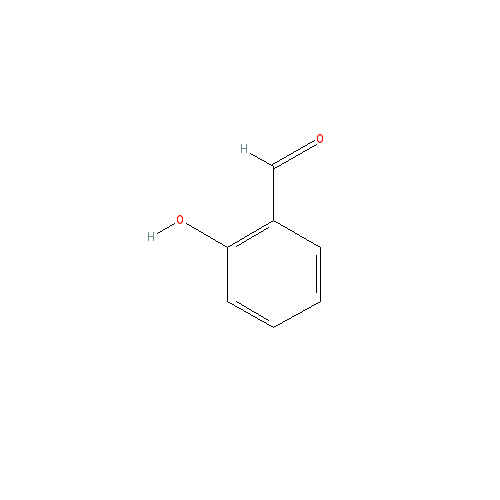
2-Hydroxybenzaldehyde
Salicylic aldehyde · o-Hydroxybenzaldehyde · 2-Formylphenol
化学組成 · Constituent
Salicylaldehyde là phenol thế nên hoạt tính axit yếu và có thể ăn mòn mô. Là cấu tử nhỏ trong tinh dầu cassia.
Trên da. Dạng nguyên chất gây kích ứng trung bình đến nặng trên da thỏ. Ở 2 phần trăm trên 33 tình nguyện không kích ứng và không gây mẫn cảm. Trên 747 bệnh nhân nghi dị ứng hương liệu, 1 phản ứng với 2 phần trăm salicylaldehyde, tỉ lệ 0.13 phần trăm.
Đường uống. LD50 cấp tính trên chuột 520 mg/kg. LD50 dưới da 900 mg/kg. Liều tử vong tối thiểu 1.0 g/kg. LD50 da trên thỏ 3.0 g/kg.
Mãn tính. Chuột ăn 2 phần trăm salicylaldehyde trong 13 ngày có giảm rõ tế bào basophilic ở gan và cạn kiệt hạt zymogen ở tuyến tuỵ.
Sinh sản. Tiêm dưới da 136 mg/kg cho chuột mang thai tăng đáng kể tỉ lệ tái hấp thu thai 17.9 phần trăm, dị tật 20.9 phần trăm và độc tính 46.1 phần trăm. Hợp chất gây hạ calci huyết mẹ, có thể liên quan đến độc tính bào thai.
Gan. Salicylaldehyde ức chế hô hấp tế bào gan và cạn glutathione, có độc tính tế bào đáng kể.
Đột biến gen. Không gây đột biến trong Ames test. Không cảm ứng SCE trong tế bào lympho người.
Salicylaldehyde is a substituted phenol with weak acid activity and tissue corrosive potential. It is a minor constituent of cassia oils.
Skin. Undiluted material was moderately to severely irritating to rabbit skin. At 2 percent on 33 volunteers it was neither irritating nor sensitizing. Among 747 dermatitis patients suspected of fragrance allergy, 1 reacted to 2 percent salicylaldehyde, a rate of 0.13 percent.
Oral. Acute oral LD50 in rats was 520 mg/kg. Acute subcutaneous LD50 was 900 mg/kg. Minimum lethal dose was 1.0 g/kg. Acute dermal LD50 in rabbits was 3.0 g/kg.
Subchronic. Rats fed 2 percent dietary salicylaldehyde for 13 days showed marked decrease in cytoplasmic basophilic bodies in liver cells and depletion of zymogen granules from pancreatic acinar cells.
Reproductive. Subcutaneous administration at 136 mg/kg in pregnant rats caused significant increases in fetal resorptions at 17.9 percent, malformations at 20.9 percent and toxicity at 46.1 percent. The compound induced maternal hypocalcemia, possibly related to the fetal toxicity.
Liver. Salicylaldehyde inhibited hepatocyte respiration and depleted hepatocyte glutathione, with appreciable cytotoxicity.
Mutagenicity. Not mutagenic in the Ames test. Did not induce SCE in human lymphocytes.
| Quế Cassia · Cassia | 0.05 – 3.1 % |
| Quế (vỏ) · Cinnamon bark | 0.04 – 1.8 % |
Sau khi oxi hoá, axit salicylic là chất chuyển hoá chính ở thỏ, mèo và chó.
After oxidation, salicylic acid is the major metabolite in rabbits, cats and dogs.
Độc tính của salicylaldehyde có thể giải thích một phần độ độc của tinh dầu cassia, nhưng tinh dầu cassia chứa nhiều hợp chất khác như cinnamaldehyde với độc tính cao hơn.
Salicylaldehyde toxicity contributes in part to the toxicity profile of cassia oil, though cassia oil contains other compounds such as cinnamaldehyde with greater toxicity.