Perillyl alcohol
4-(1-Methylethenyl)-1-cyclohexene-1-methanol
Perilla alcohol · Perillic alcohol · p-Mentha-1,8-dien-7-ol · Isocarveol
化学組成 · Constituent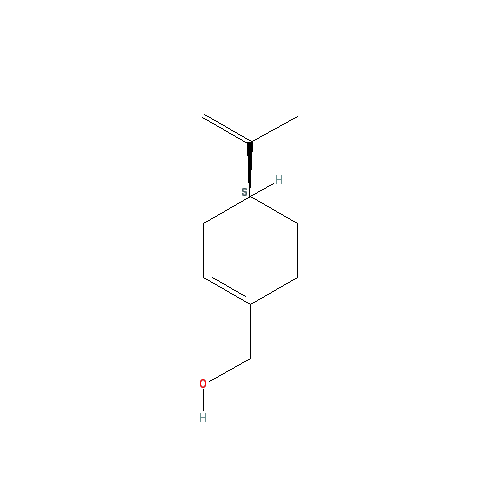
4-(1-Methylethenyl)-1-cyclohexene-1-methanol
Perilla alcohol · Perillic alcohol · p-Mentha-1,8-dien-7-ol · Isocarveol
化学組成 · Constituent
Perillyl alcohol là chất chuyển hoá của limonene và xuất hiện ở lượng nhỏ trong tinh dầu tía tô. An toàn dùng ngoài da. Khi uống liều cao đường y học, hợp chất gây buồn nôn và mệt mỏi.
Trên da. Patch test ở 4 phần trăm trên 25 tình nguyện không kích ứng và không mẫn cảm. Trong thử nghiệm lâm sàng pha 1 cho ung thư da, 0.76 phần trăm bôi ngoài hai lần mỗi ngày trong 30 ngày không gây độc tính ngoài da hay toàn thân.
Đường uống. LD50 cấp tính trên chuột 2.1 g/kg. LD50 da trên thỏ vượt 5 g/kg. MTD chế độ ăn trên chuột trong 6 tuần là 2.5 g/kg.
Độc tính trên người. Trong nhiều thử nghiệm lâm sàng giai đoạn 1 và 2, liều uống 1.200 đến 8.400 mg/m2 mỗi ngày, tương đương 31 đến 218 mg/kg, gây buồn nôn, nôn, mệt mỏi và rối loạn tiêu hoá ở phần lớn bệnh nhân, thường giới hạn liều điều trị.
Tim mạch và hô hấp. Trong một thử nghiệm xịt mũi 55 mg bốn lần mỗi ngày trong 6 tháng cho bệnh nhân u não, không quan sát thấy độc tính lâm sàng. Các xét nghiệm máu và sinh hoá vẫn bình thường.
Perillyl alcohol is a metabolite of limonene and occurs at small levels in perilla oil. It is safe for topical use. At high oral doses used in clinical research it causes nausea and fatigue.
Skin. Patch testing 25 volunteers with 4 percent showed neither irritation nor sensitization. In a phase 1 trial for skin cancer, 0.76 percent applied twice daily for 30 days produced no cutaneous or systemic toxicity in 25 subjects.
Oral. Acute oral LD50 in rats was 2.1 g/kg. Acute dermal LD50 in rabbits exceeded 5 g/kg. The 6-week dietary MTD in rats was 2.5 g/kg.
Human toxicity. Across multiple phase 1 and 2 clinical trials, oral doses of 1,200 to 8,400 mg/m2 per day, equivalent to 31 to 218 mg/kg, caused nausea, vomiting, fatigue and gastrointestinal distress in most patients, often limiting the therapeutic dose.
Cardiovascular and respiratory. In an intranasal trial of 55 mg four times daily for 6 months in brain cancer patients, no clinical signs of toxicity were observed. Hematological and biochemical parameters remained normal.
| Tía tô · Perilla | 5.4 % |
Perillyl alcohol, giống limonene, được chuyển hoá nhanh thành axit perillic, axit dihydroperillic và một lượng nhỏ metyl ester ở cả chuột và người. Cả hai đồng phân (Z) và (E) của axit dihydroperillic được tìm thấy với lượng tương đương, cùng một lượng nhỏ perillyl alcohol không chuyển hoá.
Perillaldehyde là chất chuyển hoá trung gian chính trong dòng chuyển hoá.
Perillyl alcohol, like limonene, is rapidly metabolized to perillic acid, dihydroperillic acid and small amounts of their methyl esters in both rats and humans. Both (Z) and (E) isomers of dihydroperillic acid are found in equal amounts, along with a small amount of unchanged perillyl alcohol.
Perillaldehyde is a major intermediary metabolite in this pathway.
Perillyl alcohol được nghiên cứu rộng rãi như tác nhân dự phòng ung thư. Hợp chất cảm ứng apoptosis trong nhiều dòng tế bào ung thư và ức chế tăng sinh khối u ở chuột mô hình ung thư vú, đại tràng, phổi, da và u não.
Thường được nhắc đến không chính thức như cấu tử của tinh dầu lavender, nhưng các phân tích thành phần hiện không xác nhận sự hiện diện này.
Perillyl alcohol has been extensively studied as a chemopreventive agent. It induces apoptosis in numerous cancer cell lines and inhibits tumor growth in mouse models of breast, colon, lung, skin and brain cancer.
It is often cited anecdotally as a lavender oil constituent, though current compositional analyses do not confirm this presence.