Nootkatone
1,2,3,5,6,7,8,8a-Octahydro-1,8a-dimethyl-7-(1-methylethenyl)-naphthalene-3-one
1(10),11-Eremophiladien-2-one
化学組成 · Constituent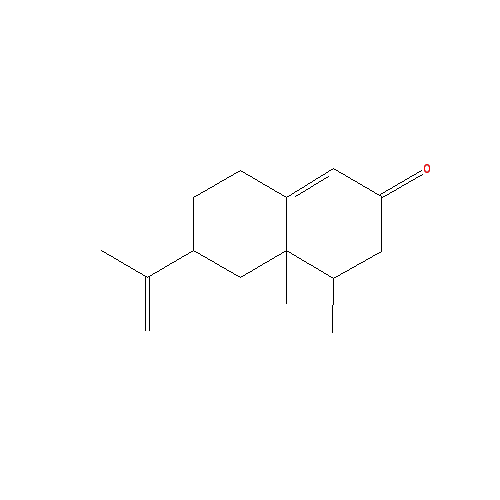
1,2,3,5,6,7,8,8a-Octahydro-1,8a-dimethyl-7-(1-methylethenyl)-naphthalene-3-one
1(10),11-Eremophiladien-2-one
化学組成 · Constituent
Nootkatone là một sesquiterpenoid ketone tạo nên mùi đặc trưng của bưởi. Hợp chất an toàn ở dạng tinh khiết cao, nhưng các mẫu kém tinh khiết có thể gây mẫn cảm.
Trên da. Nootkatone không gây kích ứng ở 10 phần trăm trên ba nhóm tình nguyện viên 25, 25 và 28 người. Mẫu 86 phần trăm tinh khiết gây một phản ứng mẫn cảm trên 25 người tình nguyện. Mẫu 86 phần trăm khác ở 10 phần trăm gây ba phản ứng mẫn cảm trên 28 nam tình nguyện. Mẫu 98 phần trăm tinh khiết không gây mẫn cảm.
Khi 1 phần nootkatone trộn với 4 phần limonene, hoạt tính mẫn cảm bị đối kháng. Tinh dầu bưởi (khoảng 90 phần trăm limonene) và bergamot (27 đến 52 phần trăm limonene) thường an toàn nhờ tỷ lệ này.
Độc tính cấp. LD50 cấp tính trên chuột qua đường uống vượt 5 g/kg. LD50 cấp tính qua da trên thỏ vượt 5 g/kg.
Nootkatone is a sesquiterpenoid ketone that gives grapefruit its characteristic aroma. The compound is safe in high purity form, but less pure samples may cause sensitization.
Skin. Nootkatone caused no irritation at 10 percent on three groups of 25, 25 and 28 volunteers. An 86 percent pure sample elicited one sensitization reaction on 25 volunteers. Another 86 percent sample at 10 percent elicited three sensitization reactions on 28 male volunteers. A 98 percent pure sample caused no sensitization.
When 1 part nootkatone is mixed with 4 parts limonene, sensitization activity is counteracted. Grapefruit oil (approximately 90 percent limonene) and bergamot (27 to 52 percent limonene) are typically safe through this ratio.
Acute toxicity. Acute oral LD50 in rats exceeded 5 g/kg. Acute dermal LD50 in rabbits exceeded 5 g/kg.
| Bưởi · Grapefruit | 0.1 – 0.8 % |
| Cam Bergamot · Bergamot | 0.01 – 0.1 % |
Con đường chuyển hoá nootkatone ở thỏ qua oxi hoá nhóm isopropenyl rồi hydrat hoá. Sáu thỏ đực trung bình 2.5 kg uống 2 g nootkatone, hai chất chuyển hoá nước tiểu được nhận diện: (+)-nootkatone-13,14-diol (chất chính, khoảng 35 phần trăm chất chuyển hoá trung tính) và (+)-nootkatone-13,14-diol monoacetate.
The metabolic pathway of nootkatone in rabbits goes via epoxidation of the isopropenyl group followed by hydration. Six male rabbits with an average body weight of 2.5 kg given 2 g of nootkatone orally produced two urinary metabolites: (+)-nootkatone-13,14-diol (the major metabolite at approximately 35 percent of neutral metabolites) and (+)-nootkatone-13,14-diol monoacetate.
Nootkatone được nghiên cứu như chất đẩy côn trùng tự nhiên, đặc biệt chống ve và muỗi. EPA Hoa Kỳ chấp thuận nootkatone làm thuốc trừ sâu sinh học.
Nootkatone has been studied as a natural insect repellent, particularly against ticks and mosquitoes. The US EPA has approved nootkatone as a biological pesticide.